Cart
Your cart is empty
Find
16-mer · mitochondrial-encoded peptide
A 16-residue peptide encoded inside the mitochondrial 12S rRNA gene rather than the nuclear genome. Supplied as a lyophilized powder for research purposes only.
Launch Sale · Ends Nov 6
Tested lot by lot at ≥99% purity. The Janoshik certificate for your lot is emailed with the order.
Everything Valtrax Research ships is bench material for in-vitro work. None of it is a drug, a supplement, a cosmetic, or a medical device, and none of it is intended for human or animal use, ingestion, or administration. Placing an order is your confirmation that you are a qualified researcher buying for lawful research, under every Canadian law and regulation that applies to you.
A 16-residue peptide whose coding sequence sits not in the nuclear genome but inside the mitochondrial 12S rRNA gene — an open reading frame the organelle carries itself. That address is the whole point: MOTS-c is something the mitochondrion encodes, which casts the organelle as a source of signals, not only a generator of ATP.
Where it goes under stress is the rest of the point. Metabolic pressure sends the peptide to the nucleus, where it alters gene expression — which is why the bench work converges on AMPK, the folate–methionine cycle, and the cell’s adaptive metabolic program.
The findings group into three. The founding cluster sits on AMPK and the folate–methionine–purine axis, with insulin sensitivity and obesity endpoints attached. A mechanistic cluster tracks stress-triggered movement into the nucleus and the transcriptional shift that follows. A physiological cluster, from the exercise literature, measures circulating MOTS-c against age-related physical decline.
The founding result is Lee’s 2015 paper, which linked MOTS-c to AMPK activation, the folate–methionine–purine cycle, and recovered insulin sensitivity in metabolically stressed tissue. What made it notable was the source: a bioactive peptide written into mitochondrial DNA, acting back on the metabolism of the whole cell.
Reynolds widened the picture toward physiology. Circulating MOTS-c was found to climb with physical activity and to fall along with age-related muscle decline — pulling the readouts out of pure metabolism and into exercise and aging.
The peptide entered the record in 2015, when scans of the mitochondrial genome for small open reading frames turned up a coding sequence inside the 12S rRNA gene. It landed alongside humanin in what was then a fresh category — the mitochondrial-derived peptides.
The finding carried a larger claim than a single molecule. It recast the mitochondrion as a signaling hub that answers back to the nucleus, and the studies that followed traced that exchange across metabolism, the stress response, and aging.
In vitro and animal studies
MOTS-c is a 16-residue peptide encoded within the mitochondrial genome rather than the nuclear genome — one of a small class of mitochondrial-derived peptides identified only in the last fifteen years. Its discovery was conceptually significant: it demonstrated that mitochondria signal to the rest of the cell using peptides of their own, not merely through metabolites and reactive oxygen species.
The core preclinical finding is metabolic. Published work reports that MOTS-c activates AMPK, the cellular energy sensor, and in doing so influences fatty acid oxidation, glucose handling and insulin sensitivity. Mouse studies describe protection against diet-induced obesity and improved insulin sensitivity, with effects on the folate-methionine cycle proposed as an upstream mechanism.
A second strand concerns exercise. MOTS-c has been reported to translocate to the nucleus under metabolic stress and regulate nuclear gene expression, which is unusual for a mitochondrial peptide. Studies in aged mice reported improved physical capacity following administration, and the compound is frequently described in its own literature as an exercise mimetic.
Human data, where it exists
No controlled interventional trials of MOTS-c administration in humans have been published. There is no human efficacy data, no human safety dataset, and no established pharmacokinetic profile.
The human data that does exist is observational. Circulating MOTS-c has been measured in human cohorts, with reported declines associated with age and differences associated with metabolic status and exercise. A well-cited observation concerns a MOTS-c polymorphism reported at higher frequency in Japanese populations with exceptional longevity.
Those are association findings. They establish that the peptide is present, measurable and correlated with physiological states of interest. They do not establish that administering it produces any effect in people, which is a fundamentally different claim requiring interventional evidence that has not been generated.
Common assertions, and what the record supports
The claim that MOTS-c is exercise in a vial derives from mouse studies reporting improved physical capacity, and it overstates them considerably. Even accepting the rodent findings, exercise produces mechanical, cardiovascular, neurological and endocrine adaptations that AMPK activation does not reproduce.
The claim that declining MOTS-c causes age-related metabolic decline, and that restoring it reverses that decline, moves from correlation to causation without the intervening evidence. Levels falling with age is an observation; the causal direction has not been established in humans, and many things decline with age without being the cause of it.
The longevity polymorphism finding is genuinely interesting and frequently misrepresented. An association between a genetic variant and longevity in a population does not demonstrate that administering the peptide extends life.
The strongest honest statement is that MOTS-c is a real signalling molecule with a coherent mechanism and no human interventional data.
Against the compounds it is most often confused with
Against SS-31 on the same shelf, both are mitochondrially focused but act completely differently. SS-31 is a synthetic tetrapeptide that physically localises to the inner mitochondrial membrane and binds cardiolipin, stabilising the structural platform of the electron transport chain. MOTS-c is an endogenous mitochondrially encoded peptide acting as a signalling molecule through AMPK and nuclear gene regulation. Structural stabilisation versus metabolic signalling.
Against NAD+, the relationship is complementary: NAD+ is the redox cofactor substrate, while MOTS-c modulates the signalling that governs how energy metabolism is regulated. AMPK and sirtuin pathways intersect, so the two are conceptually adjacent.
Against SLU-PP-332 on the metabolic shelf, the resemblance is strong at the level of research framing — both are described as exercise mimetics — but the mechanisms differ entirely, ERR-driven transcription versus AMPK activation.
Adverse findings, toxicology gaps, material hazards
The absence of human interventional data is the dominant risk. No adverse effect profile, no interaction data and no safe exposure range has been characterised in people.
AMPK is not a niche target. It is a master regulator of cellular energy metabolism active in essentially every tissue, and its activation influences protein synthesis, autophagy, lipid metabolism and cell growth. Pharmacologically activating a master regulator systemically has consequences well beyond the endpoints the rodent studies measured, and those have not been mapped.
The reported nuclear translocation and regulation of nuclear gene expression means the peptide is not confined to metabolic signalling in the cytoplasm. A compound that alters nuclear gene expression warrants more caution than one acting on a single receptor, and the transcriptional consequences have not been characterised in humans.
Chronic toxicology has not been published in any species at the exposures discussed. Effects on cell growth regulation, given AMPK's role in that process, remain uncharacterised.
Bench practice for this compound
MOTS-c ships lyophilized. Reconstitute with bacteriostatic water directed against the vial wall rather than onto the powder cake, and swirl gently until dissolved; do not shake.
Store reconstituted material at 2–8 °C protected from light and observe the working window on this page. Unopened lyophilized powder held frozen is stable considerably longer. Aliquot before freezing rather than cycling a vial through repeated thaws.
This summary describes published research. It is not a protocol, not a recommendation, and not a statement that this compound is safe or effective for any use. Not for human or animal use.
Lee, C. et al. (2015). The mitochondrial-derived peptide MOTS-c promotes metabolic homeostasis and reduces obesity and insulin resistance.
PubMedKim, S.J. et al. (2017). Mitochondrially derived peptides as novel regulators of metabolism.
PubMedReynolds, J.C. et al. (2021). MOTS-c is an exercise-induced mitochondrial-encoded regulator of age-dependent physical decline and muscle homeostasis.
PubMedCobb, L.J. et al. (2016). Naturally occurring mitochondrial-derived peptides are age-dependent regulators of apoptosis, insulin sensitivity, and inflammatory markers. Aging (Albany NY) 8(4):796–809.
PubMedMerry, T.L. et al. (2020). Mitochondrial-derived peptides in energy metabolism.
PubMedThe certificate for your lot reports measured identity, purity, and net content, and is sent by email.
Janoshik Analytical, a laboratory Valtrax does not own, runs the testing — identity by mass spectrometry, purity by RP-HPLC at ≥99%, on the lot you receive.
Same Shelf
Longevity & Mitochondrial
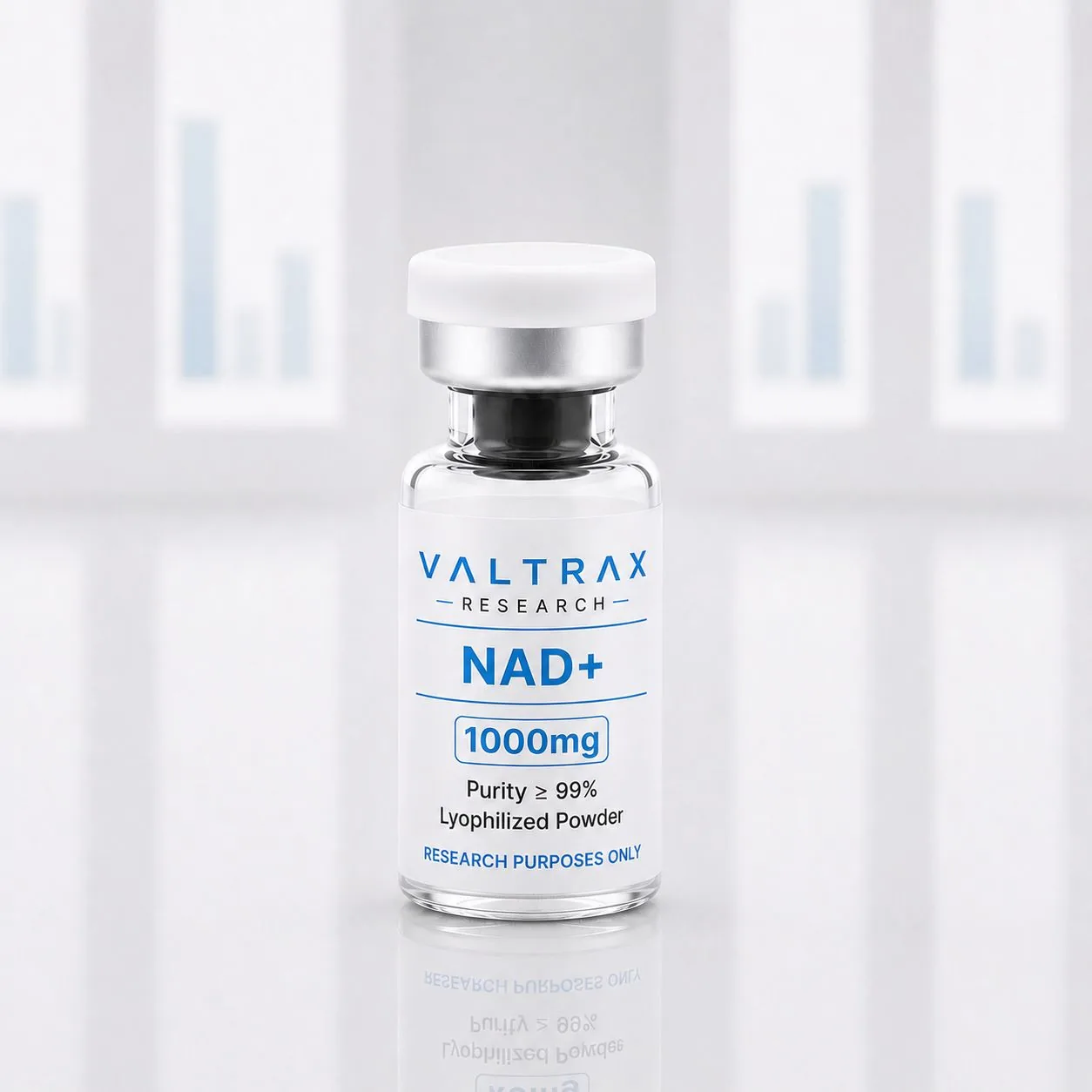
$80.00
$100.00
1000mg
Nicotinamide adenine dinucleotide, the redox coenzyme that shuttles electrons through nearly every cellular redox step. Supplied as a lyophilized powder for research purposes only.
Longevity & Mitochondrial
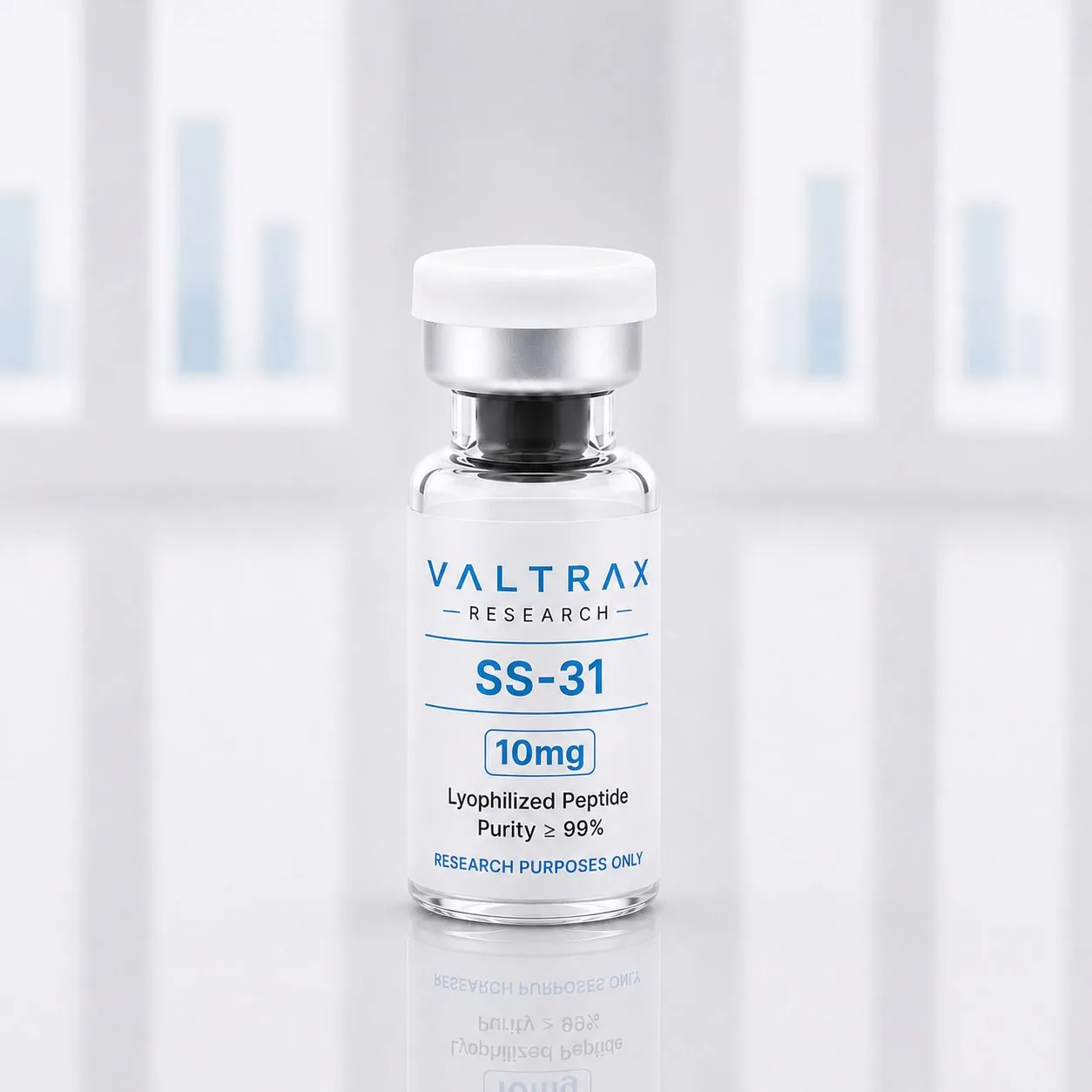
$56.00
$70.00
10mg
A cardiolipin-binding tetrapeptide (D-Arg-Dmt-Lys-Phe), also filed as elamipretide. Supplied as a lyophilized powder for research purposes only.
Longevity & Mitochondrial
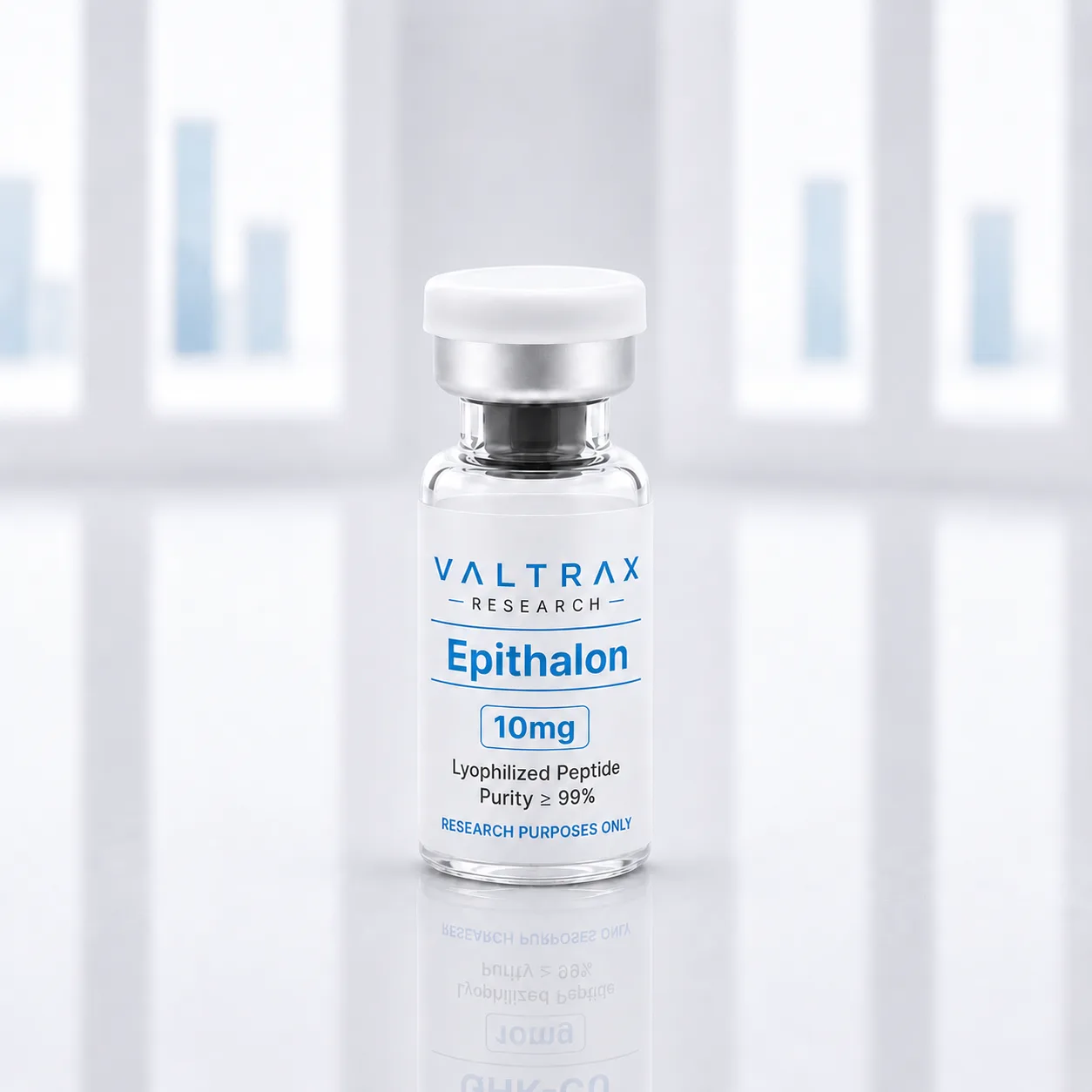
$32.00
$40.00
10mg