Valtrax Research is opening — leave your email and we'll ping you the moment the first compounds are listed.
Every lot tested by Janoshik Analytical


Cart
Your cart is empty
Find
Valtrax Research is opening — leave your email and we'll ping you the moment the first compounds are listed.
Your cart is empty
Bremelanotide · melanocortin agonist heptapeptide
Bremelanotide. A synthetic cyclic heptapeptide analog of alpha-melanocyte-stimulating hormone. Supplied as a lyophilized powder for research purposes only.
Catalog opens shortly. Leave your address and we will ping you the moment this compound is orderable.
Tested lot by lot at ≥99% purity. The Janoshik certificate for your lot is emailed with the order.
Everything Valtrax Research ships is bench material for in-vitro work. None of it is a drug, a supplement, a cosmetic, or a medical device, and none of it is intended for human or animal use, ingestion, or administration. Placing an order is your confirmation that you are a qualified researcher buying for lawful research, under every Canadian law and regulation that applies to you.
PT-141 — bremelanotide in the journals — is the active metabolite that survived when Melanotan II was put through metabolism. Strip the C-terminal amide and what remains is a cyclic heptapeptide that drops MT-II’s pigment-driving baggage and keeps the central melanocortin activity, with MC4R the receptor of interest.
That narrowing is the point. Rather than the broad tanning response of its parent, PT-141 reads through the hypothalamic melanocortin circuitry, which is the lane essentially all of its study sits in.
The work splits cleanly: receptor pharmacology on one side — how the heptapeptide engages MC4R and the other melanocortin subtypes — and behavioral/clinical endpoints on the other, where its central (not vascular) mode of action is the recurring contrast. The bremelanotide trial set supplies most of the human data.
Mechanistically PT-141 is a non-selective melanocortin agonist that matters mainly at MC4R, the receptor sitting in the hypothalamic pathways tied to sexual arousal. Unlike PDE5-type approaches, its activity is central rather than vascular, which is the distinction the literature returns to again and again.
The clinical record runs from Diamond’s early intranasal pharmacology through Clayton’s dose-finding to the Kingsberg Phase 3 program that anchored the bremelanotide approval. Borland’s 2025 hamster work adds the preclinical behavioral angle, keeping the molecule grounded in the melanocortin circuitry it was narrowed down to hit.
PT-141 is a deliberate offshoot of Melanotan II. When MT-II was studied for pigmentation, an unexpected arousal signal turned up; chemists chased that effect, deamidated the parent, and arrived at a heptapeptide that kept the central activity while shedding the tanning response.
From there it moved into its own development line under the name bremelanotide — first explored by an intranasal route, later reformulated and carried through controlled trials as a melanocortin-targeted agent.
In vitro and animal studies
PT-141, bremelanotide, is a cyclic heptapeptide and a metabolite of Melanotan II. Its pharmacology is defined by where it acts: melanocortin receptors in the central nervous system, principally MC4R and MC3R, rather than the peripheral vascular pathway targeted by PDE5 inhibitors.
That distinction was the point of its development. Preclinical work in rodent models reported increases in measures of sexual motivation and solicitation behaviour, effects mediated centrally and observable independently of peripheral vascular changes. Studies localised activity to hypothalamic regions involved in sexual response, and the melanocortin system's broader role in appetite, energy balance and inflammation was mapped alongside.
The compound's origin is worth noting because it explains the safety profile. PT-141 emerged from work on Melanotan II when investigators observed sexual-function effects as a side finding during tanning research. Bremelanotide was then developed as the more selective metabolite, retaining the central sexual-function activity while reducing the pigmentary and other off-target melanocortin effects.
The receptor pharmacology explains an otherwise puzzling feature of the record. Melanocortin receptors are a family of five, and their distribution determines what any agonist does: MC1R on melanocytes governs pigmentation, MC2R in the adrenal cortex mediates ACTH signalling, MC3R and MC4R in the central nervous system govern energy balance and sexual function, and MC5R has exocrine roles.
Bremelanotide's selectivity for MC3R and MC4R over MC1R is what separates it from its parent compound, and it is a matter of degree rather than of kind. That residual MC1R activity is why hyperpigmentation still appears in the adverse effect record of an approved product designed specifically to avoid it.
Human data, where it exists
PT-141 has genuine regulatory standing. It was approved by the FDA in 2019 as Vyleesi for hypoactive sexual desire disorder in premenopausal women, following the RECONNECT phase 3 programme — randomised, double-blind, placebo-controlled trials that reported statistically significant improvements in desire and in distress associated with low desire.
The effect sizes were modest and generated genuine debate about clinical meaningfulness, which is a fair summary of the record rather than a criticism of it. Earlier development had explored erectile dysfunction, including intranasal formulations; that route was discontinued after blood pressure increases were observed, and the programme was redirected to subcutaneous administration and the HSDD indication.
That history is unusually informative. The blood pressure signal is not a theoretical concern derived from mechanism — it is the documented reason a development pathway was abandoned.
Common assertions, and what the record supports
The claim that PT-141 works through a mechanism unlike PDE5 inhibitors is correct and important. It acts centrally on desire pathways rather than peripherally on vascular smooth muscle, which is why it was studied in populations where PDE5 inhibitors are not applicable.
The claim that it is a general-purpose libido enhancer overstates the record. The approved indication is narrow, the trial population specific, and the measured effect modest. Efficacy in men is supported by earlier development work but not by an approval.
The claim most worth correcting is that PT-141 is a safer Melanotan II. It is more selective, which is real. But the cardiovascular signal that ended the intranasal programme belongs to PT-141 itself, not to its parent compound, and transient blood pressure elevation is documented in the approved product's own labelling.
Against the compounds it is most often confused with
Against Melanotan II, PT-141 is the selective metabolite. Melanotan II is a non-selective melanocortin agonist whose dominant documented action is MC1R-mediated melanogenesis, with appetite and sexual effects following from MC3R and MC4R engagement. PT-141 largely drops the pigmentary arm and retains the central sexual-function activity. That is a meaningful improvement in selectivity and not an elimination of melanocortin-class effects.
Against Kisspeptin-10, both touch sexual function but at completely different levels. Kisspeptin acts upstream on GnRH neurons governing the reproductive endocrine axis — LH, FSH, gonadal steroids. PT-141 acts on melanocortin receptors in desire pathways without driving the hormonal axis.
Against PDE5 inhibitors, the contrast is central versus peripheral, desire versus vascular response — the reason it occupies a distinct clinical niche.
Adverse findings, toxicology gaps, material hazards
Nausea is the most common adverse effect and it is not marginal: it was reported in a large proportion of trial participants, and it was severe enough in some to cause discontinuation.
Transient increases in blood pressure with corresponding decreases in heart rate are documented, which is why the approved product is contraindicated in uncontrolled hypertension and in known cardiovascular disease. This is the same signal that ended the intranasal erectile dysfunction programme, and it is the most clinically important risk attached to the compound.
Focal hyperpigmentation has been reported, including on the face and gums, and is more likely with repeated administration — a residue of melanocortin activity that greater selectivity reduces without abolishing.
Flushing, headache and injection site reactions are documented. Long-term safety beyond trial durations has not been established, and the approved labelling limits frequency of use.
Bench practice for this compound
PT-141 is a cyclic heptapeptide, compact and comparatively stable. Reconstitute with bacteriostatic water directed against the vial wall and swirl gently until dissolved; avoid shaking.
Store reconstituted solutions at 2–8 °C protected from light and observe the stated working window. Unopened lyophilized powder is considerably more stable and belongs in the freezer for long-term storage. Aliquot before freezing rather than cycling one vial through repeated thaws.
This summary describes published research. It is not a protocol, not a recommendation, and not a statement that this compound is safe or effective for any use. Not for human or animal use.
Kingsberg, S.A. et al. (2019). Bremelanotide for the Treatment of Hypoactive Sexual Desire Disorder: Two Randomized Phase 3 Trials. Obstet Gynecol 134(5):899–908.
PubMedClayton, A.H. et al. (2016). Bremelanotide for female sexual dysfunctions in premenopausal women: a randomized, placebo-controlled dose-finding trial. Womens Health (Lond) 12(3):325–337.
PubMedDiamond, L.E. et al. (2004). Double-blind, placebo-controlled evaluation of the safety, pharmacokinetic properties and pharmacodynamic effects of intranasal PT-141, a melanocortin receptor agonist, in healthy males and patients with mild-to-moderate erectile dysfunction. Int J Impot Res 16(1):51–59.
PubMedBorland, J.M. et al. (2025). Female Syrian hamster analyses of bremelanotide, a US FDA approved drug for the treatment of female hypoactive sexual desire disorder.
PubMedIndependent testing lot by lot: identity, purity, net content.
Janoshik Analytical, a laboratory Valtrax does not own, runs the testing — identity by mass spectrometry, purity by RP-HPLC at ≥99%, on the lot you receive.
Same Shelf
Melanocortin & Reproductive
$60.00
10mg
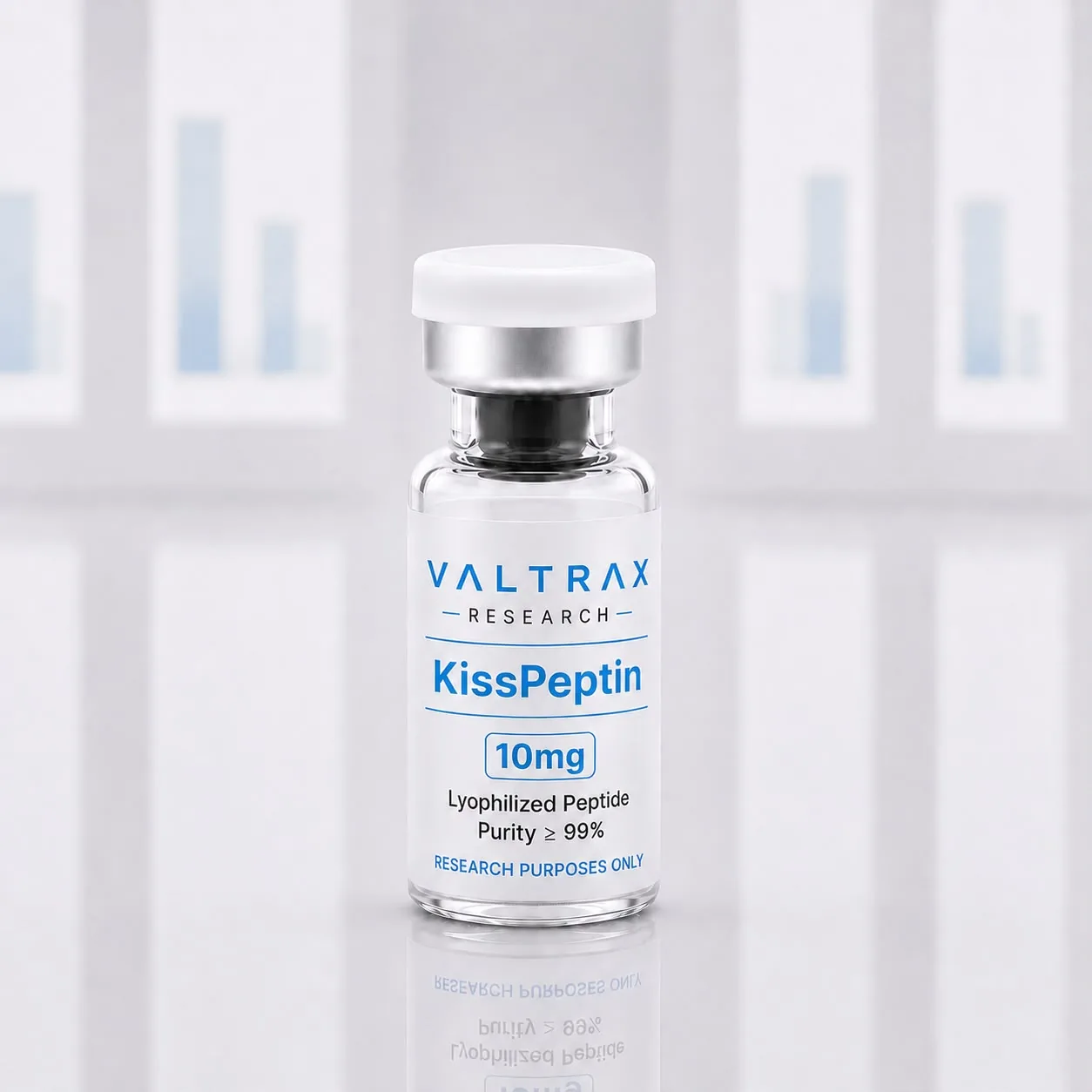
The C-terminal decapeptide of KISS1 and a full agonist at KISS1R (GPR54). Supplied as a lyophilized powder for research purposes only.
Melanocortin & Reproductive
$80.00
10mg
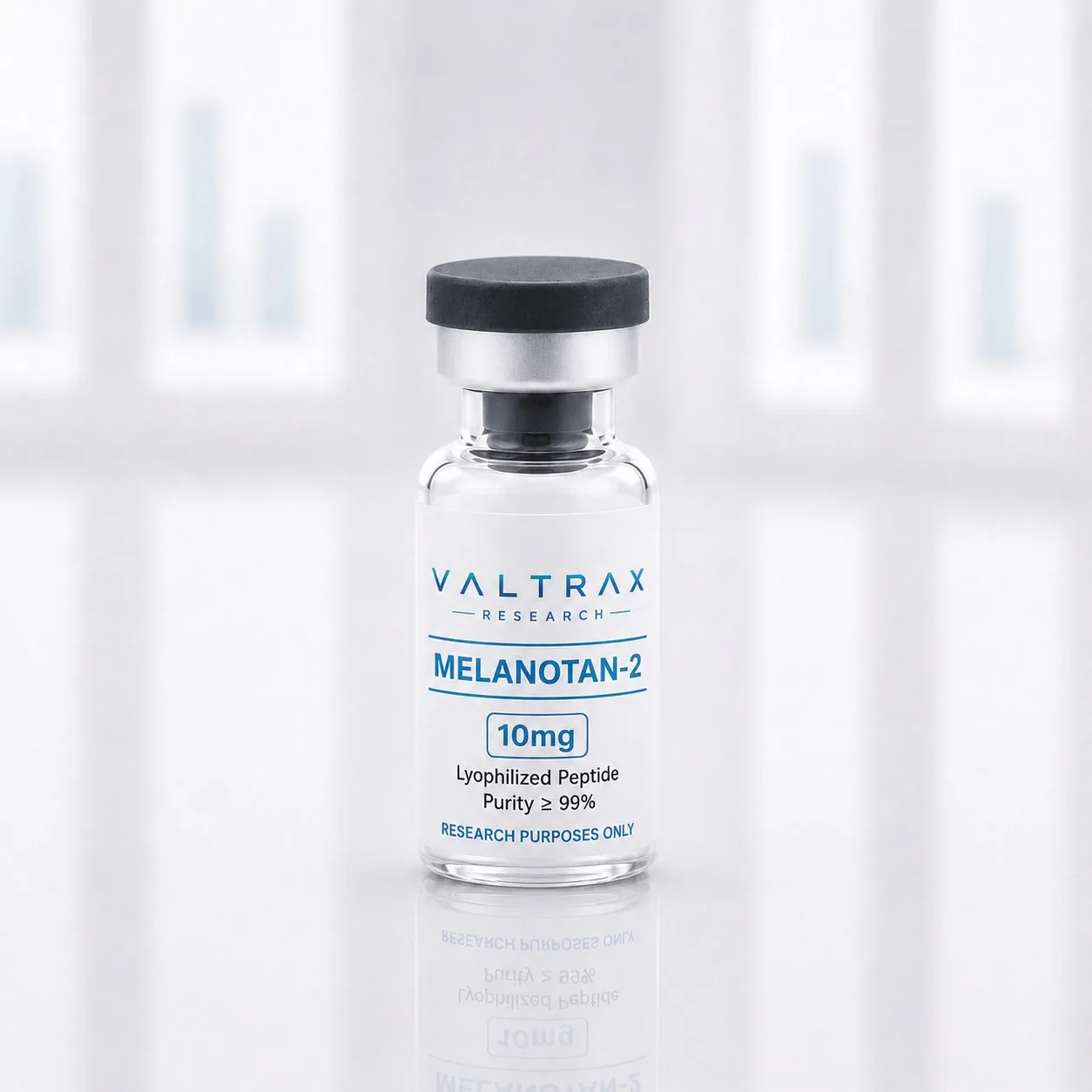
A cyclic lactam heptapeptide analogue of alpha-MSH, engineered to resist the proteases that clear the linear hormone. Supplied as a lyophilized powder for research purposes only.