Cart
Your cart is empty
Find
Decapeptide · KISS1R (GPR54) ligand
The C-terminal decapeptide of KISS1 and a full agonist at KISS1R (GPR54). Supplied as a lyophilized powder for research purposes only.
Launch Sale · Ends Nov 6
Tested lot by lot at ≥99% purity. The Janoshik certificate for your lot is emailed with the order.
Everything Valtrax Research ships is bench material for in-vitro work. None of it is a drug, a supplement, a cosmetic, or a medical device, and none of it is intended for human or animal use, ingestion, or administration. Placing an order is your confirmation that you are a qualified researcher buying for lawful research, under every Canadian law and regulation that applies to you.
Tyr-Asn-Trp-Asn-Ser-Phe-Gly-Leu-Arg-Phe. Ten residues off the C-terminal end of KISS1 — the part the longer kisspeptins get trimmed to in tissue, and the part that holds full activity at GPR54 (KISS1R). Everything past those ten amino acids is scaffold the receptor never needs.
GPR54 lives on GnRH neurons. Engage it and the consequence is one rung up: GnRH release, then the pituitary. That single upstream position is what makes the 10-mer a standing reagent for the switch that gates the reproductive axis.
Three bodies of work, unequal in size. The largest reads the HPG cascade — central and peripheral dosing, GnRH drive, the LH/FSH response, and its split by sex. A receptor-mechanics strand sits beneath it, mapping GPR54 occupancy and the signal it raises. A residual oncology strand carries forward from the gene’s origins as a metastasis suppressor.
Two levels of work run in parallel. At the receptor, binding and second-messenger studies read GPR54 occupancy directly — what the 10-mer touches and what it switches on. At the organism, central and peripheral dosing read the cascade it sets off: pulsatile GnRH, then LH and FSH downstream.
One finding shapes much of the human literature. Jayasena’s 2011 cohort showed the LH response splits by sex, and that dimorphism is part of why the fragment keeps reappearing wherever the reproductive gate — not the receptor alone — is the question.
The gene reached the literature through oncology, not endocrinology. KISS1 was first catalogued as a metastasis suppressor; the reproductive role only landed when GPR54 was paired with its kisspeptin ligands and loss-of-function mutations were found to stall puberty.
That second discovery moved the C-terminal decapeptide to the foreground. Short enough to synthesize cleanly, fully potent at the receptor — once the axis became the subject, it was the obvious thing to put in a vial.
In vitro and animal studies
Kisspeptin-10 is the decapeptide C-terminal fragment of kisspeptin, the neuropeptide product of the KISS1 gene. Its discovery reshaped reproductive endocrinology: the finding that loss-of-function mutations in the kisspeptin receptor GPR54 cause hypogonadotropic hypogonadism established kisspeptin as an obligatory upstream gatekeeper of the entire reproductive axis.
Mechanistically it acts on GnRH neurons in the hypothalamus, stimulating GnRH release, which drives pituitary LH and FSH secretion and downstream gonadal steroid production. That places it a full level above the pituitary — most compounds acting on this axis work at or below it.
Preclinical work covers puberty onset, where kisspeptin signalling is the trigger; the pulse generator that governs LH pulsatility, involving KNDy neurons co-expressing kisspeptin, neurokinin B and dynorphin; and the mechanism by which metabolic state gates reproductive function, since kisspeptin neurons integrate signals including leptin. The decapeptide fragment retains full receptor activity but has a short circulating half-life.
One methodological point governs how this literature should be read. Kisspeptin-10 has a circulating half-life measured in minutes, cleared rapidly by peptidases, so almost every human study has used continuous infusion or bolus administration with tightly timed sampling. Results are therefore reported against carefully controlled exposure windows.
That matters because the reproductive axis responds to pulse pattern rather than to total exposure. The KNDy neurons that generate GnRH pulsatility are themselves kisspeptin-expressing, so administering exogenous kisspeptin acts on a system already using the same signal to encode timing information. Whether an imposed exogenous signal reinforces or disrupts that encoding depends on how it aligns with the endogenous rhythm — a question the controlled single-administration studies were not designed to answer.
Human data, where it exists
Kisspeptin-10 has a genuine and growing human research literature, much of it from Imperial College London, which distinguishes it from most compounds sold as research peptides.
Human studies have established that administration produces a reproducible rise in LH, and that response has been developed as a diagnostic probe of reproductive axis function — a test of whether the GnRH neurons are capable of responding. Work has examined its use in distinguishing causes of hypogonadotropic hypogonadism, in assessing fertility, and in triggering oocyte maturation in IVF protocols, where the rationale is a lower risk of ovarian hyperstimulation syndrome than conventional triggers carry.
A separate line of published work has examined kisspeptin's effects on brain regions associated with sexual and emotional processing, including studies in men with hypoactive sexual desire.
Despite this, kisspeptin-10 holds no marketing approval for any indication. The human work is investigational, conducted under supervision, generally involving controlled single administrations.
Common assertions, and what the record supports
The claim that kisspeptin-10 raises LH is well supported by human data — this is one of the better-evidenced pharmacological claims in this catalogue.
The claim that this translates into improved fertility, testosterone or libido as a general matter is not supported. LH release is an intermediate endpoint. The human studies were designed largely to characterise axis responsiveness or to serve as a diagnostic probe, not to demonstrate downstream clinical benefit from repeated administration.
The most important unsupported assumption concerns repeated exposure. The reproductive axis is governed by pulsatility, and continuous or frequent stimulation of GnRH pathways is well known to produce desensitisation rather than sustained activation — the principle that GnRH agonists are used therapeutically to suppress the axis. Applying a kisspeptin analogue repeatedly could plausibly produce the opposite of the intended effect, and the published human work does not characterise what happens under those conditions.
Against the compounds it is most often confused with
Against PT-141, both intersect with sexual function but at unrelated levels. Kisspeptin-10 acts on the reproductive endocrine axis, driving GnRH, LH, FSH and gonadal steroids. PT-141 acts on melanocortin receptors in central desire pathways without engaging that hormonal cascade. One changes hormones; the other changes signalling in behaviour circuits.
Against the GH secretagogues, the comparison is instructive because both classes act on hypothalamic-pituitary axes but different ones — somatotropic versus gonadotropic. The shared lesson is pulsatility: both axes are governed by pulse frequency and amplitude, and both are subject to desensitisation under continuous stimulation.
Against Melanotan II, there is no mechanistic overlap; the shelf grouping reflects subject matter rather than pharmacology.
Adverse findings, toxicology gaps, material hazards
The best-characterised risk is desensitisation of the axis. This is not speculative — sustained GnRH pathway stimulation reliably downregulates gonadotropin output, which is the therapeutic basis of GnRH agonist use in suppressing reproductive function. The human kisspeptin studies overwhelmingly used single or short-course administration, so the consequences of repeated exposure are genuinely uncharacterised.
Because the compound sits at the top of the reproductive axis, its effects propagate to LH, FSH, testosterone or estradiol. Manipulating that cascade without endocrine monitoring means changing multiple hormones simultaneously with no measurement of the result.
Reported adverse effects in the controlled human studies have generally been mild, which is a real observation but comes from short, supervised protocols in screened participants.
Effects on mood and emotional processing have been reported in imaging studies, consistent with kisspeptin receptor distribution beyond the hypothalamus. The compound has a short half-life, so exposure is brief per administration.
Bench practice for this compound
Kisspeptin-10 is a decapeptide with a short circulating half-life and ships lyophilized. Reconstitute with bacteriostatic water directed against the vial wall; swirl gently rather than shaking.
Store reconstituted solutions at 2–8 °C protected from light and observe the stated working window. Keep unopened lyophilized powder frozen for long-term storage, and aliquot before freezing to avoid repeated freeze-thaw cycling.
This summary describes published research. It is not a protocol, not a recommendation, and not a statement that this compound is safe or effective for any use. Not for human or animal use.
Jayasena, C.N. et al. (2011). The effects of kisspeptin-10 on reproductive hormone release show sexual dimorphism in humans. J Clin Endocrinol Metab 96(12):E1963–E1972.
PubMedThompson, E.L. et al. (2004). Central and peripheral administration of kisspeptin-10 stimulates the hypothalamic-pituitary-gonadal axis. J Neuroendocrinol 16(10):850–858.
PubMedOlbrich, T. et al. (2010). Kisspeptin-10 inhibits bone-directed migration of GPR54-positive breast cancer cells.
PubMedJanoshik Analytical measures identity, purity, and net content, lot by lot.
Janoshik Analytical, a laboratory Valtrax does not own, runs the testing — identity by mass spectrometry, purity by RP-HPLC at ≥99%, on the lot you receive.
Same Shelf
Melanocortin & Reproductive
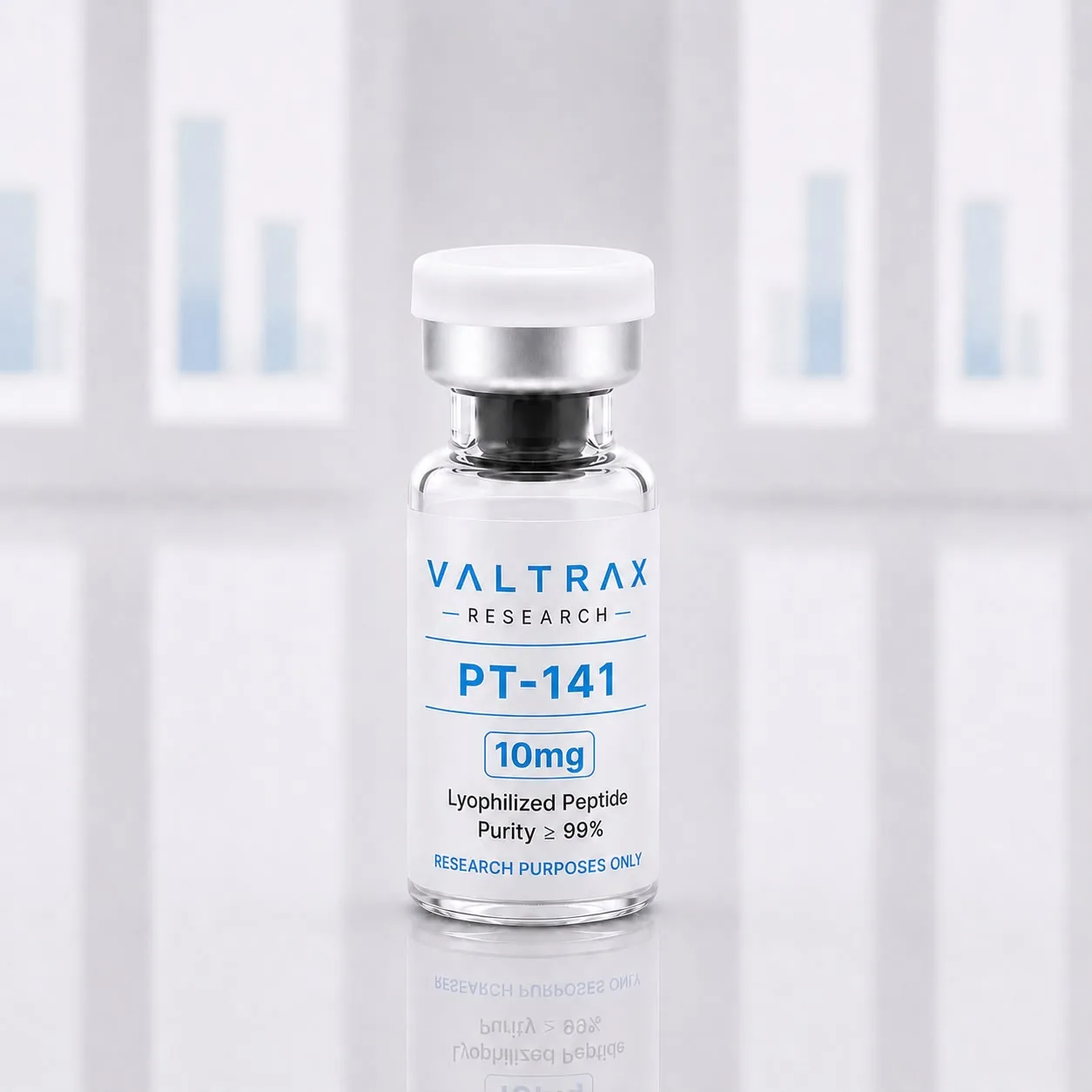
$48.00
$60.00
10mg
Bremelanotide. A synthetic cyclic heptapeptide analog of alpha-melanocyte-stimulating hormone. Supplied as a lyophilized powder for research purposes only.
Melanocortin & Reproductive
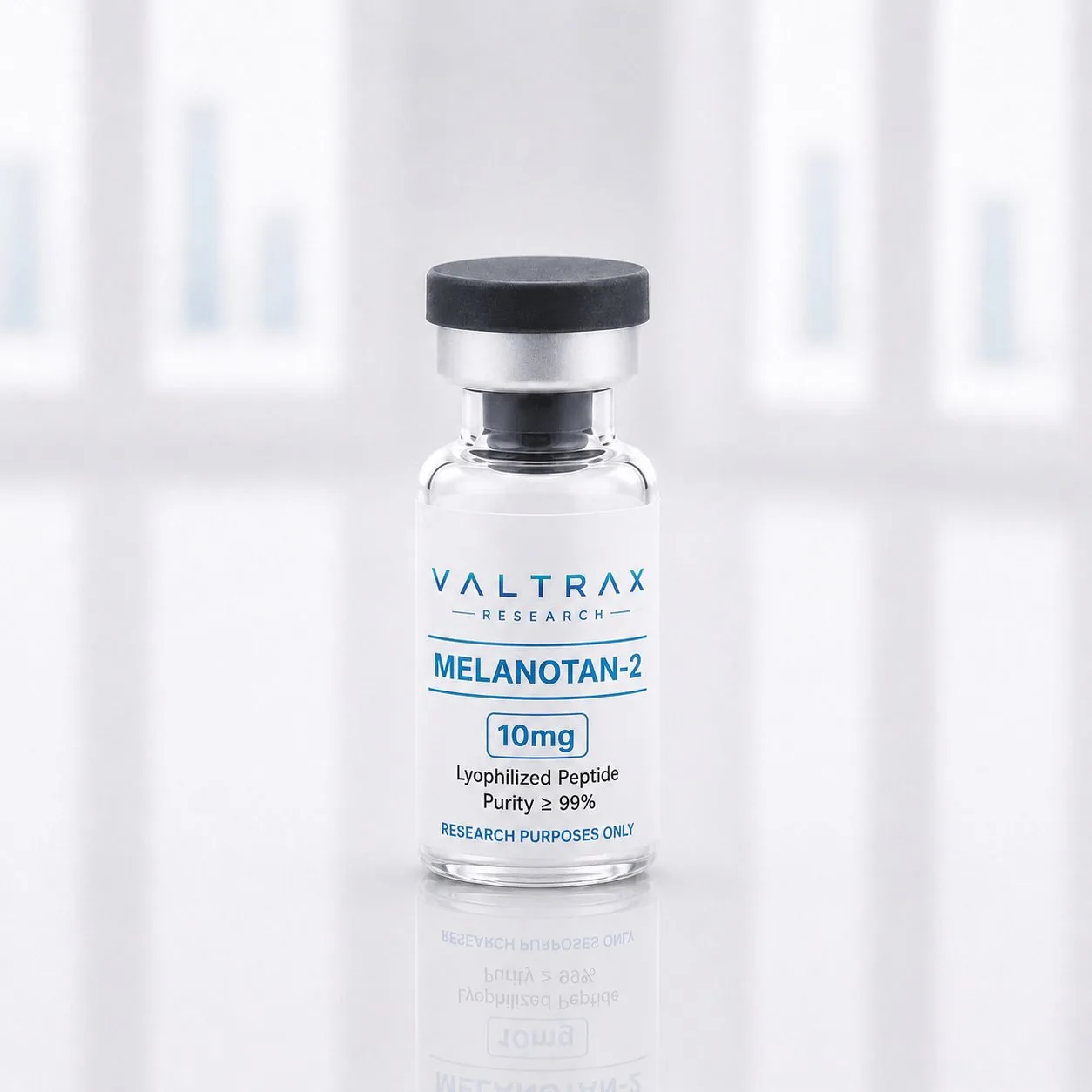
$64.00
$80.00
10mg
A cyclic lactam heptapeptide analogue of alpha-MSH, engineered to resist the proteases that clear the linear hormone. Supplied as a lyophilized powder for research purposes only.
Melanocortin & Reproductive
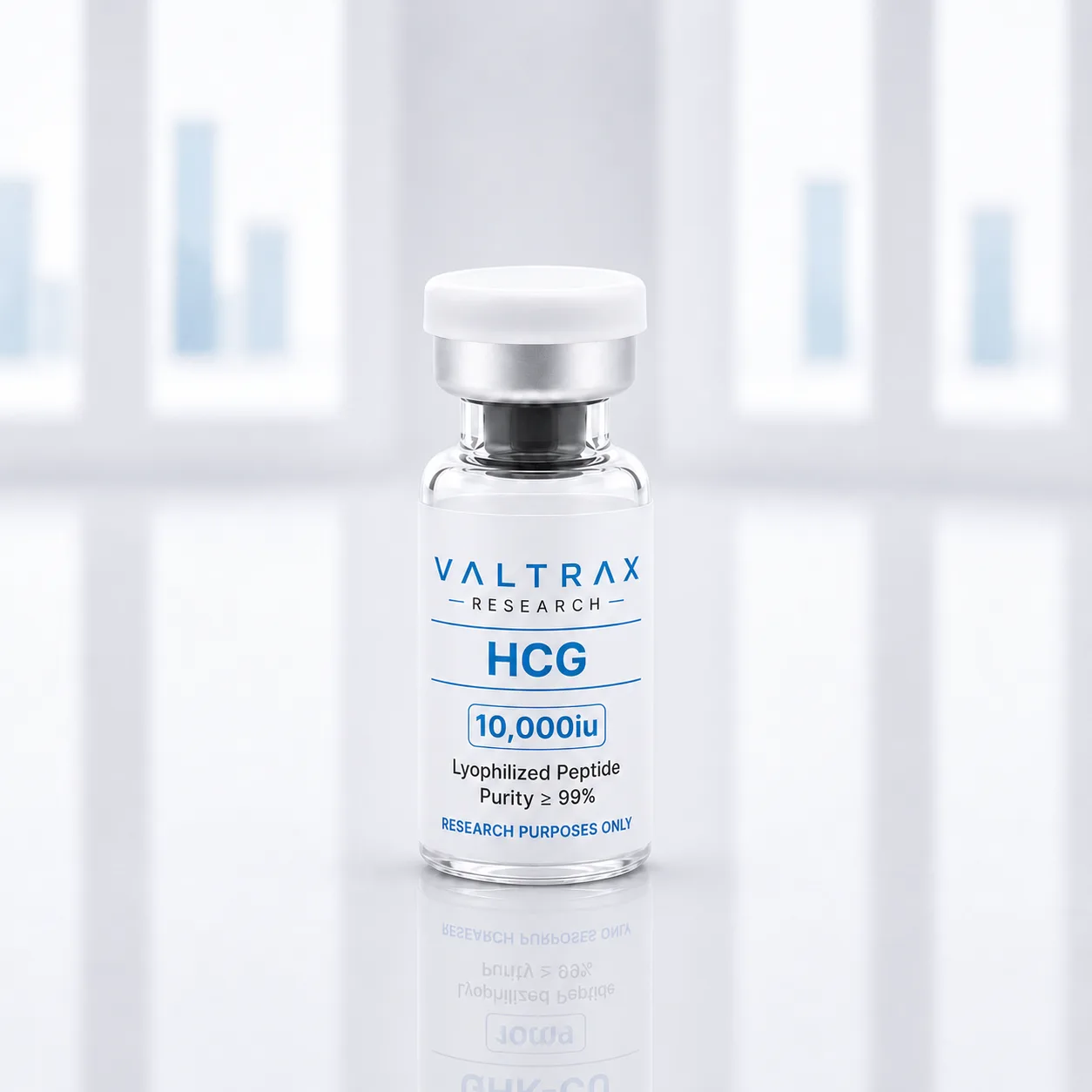
$56.00
$70.00
10,000iu