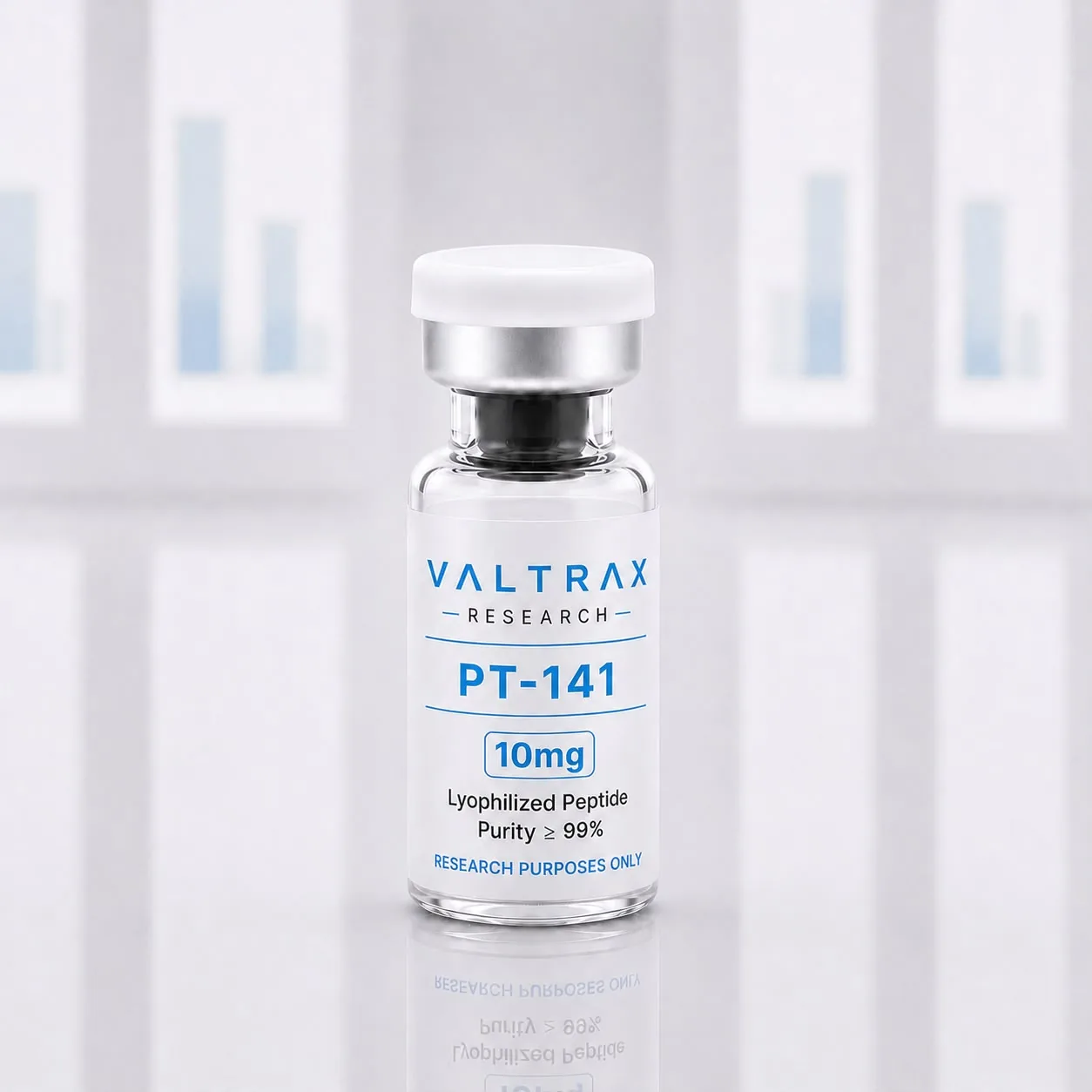
Valtrax Research is opening — leave your email and we'll ping you the moment the first compounds are listed.
Every lot tested by Janoshik Analytical


Cart
Your cart is empty
Find
Valtrax Research is opening — leave your email and we'll ping you the moment the first compounds are listed.
Your cart is empty
Pentadecapeptide · gastric-derived
Body Protection Compound-157. A 15-amino-acid peptide studied in experimental models of structural repair and angiogenic pathway regulation.
Catalog opens shortly. Leave your address and we will ping you the moment this compound is orderable.
Tested lot by lot at ≥99% purity. The Janoshik certificate for your lot is emailed with the order.
Everything Valtrax Research ships is bench material for in-vitro work. None of it is a drug, a supplement, a cosmetic, or a medical device, and none of it is intended for human or animal use, ingestion, or administration. Placing an order is your confirmation that you are a qualified researcher buying for lawful research, under every Canadian law and regulation that applies to you.
Fifteen residues, sequenced from a stretch of human gastric juice protein. BPC-157 has no native parent molecule that circulates on its own — the fragment is the article of study, made stable enough to hold up in solution where most short peptides break down.
What keeps it on the bench is reach. The same sequence shows up across tendon, vascular, and gut models, which is why the literature returns again and again to angiogenesis and the nitric-oxide axis rather than to any one tissue.
Most of the published work sits in three buckets: tissue repair, vascular response, and gut/cytoprotection. Across them the data point back to angiogenesis, eNOS-linked vascular tone, and collagen remodeling — the mechanistic spine that ties the otherwise unrelated models together.
BPC-157 — Body Protection Compound 157 — is a 15-residue fragment first written up in the early 1990s, when groups screening gastric juice for organoprotective activity isolated the parent protein and narrowed it to this stretch. The fragment proved unusually robust in aqueous conditions, which is what made it tractable to study.
The recurring threads in the work are angiogenesis, endothelial nitric-oxide signaling via the Src–Caveolin-1–eNOS route, and collagen turnover. Read together, those threads explain why connective-tissue, vascular, and cytoprotection models all keep reaching for the same sequence.
The compound came out of gastric-peptide screening, where the first models were about mucosal integrity and ulcer response. From there the question widened: tendon, ligament, vascular, and dermal preparations followed, each testing whether the same fragment behaved consistently outside the gut.
The answer was reproducible enough across labs that BPC-157 settled in as a standing reference point in preclinical repair literature.
In vitro and animal studies
BPC-157 has one of the broadest rodent literatures of any research peptide, and that breadth is simultaneously its most interesting and most suspicious feature. Published animal work reports accelerated healing in transected Achilles tendon, in medial collateral ligament injury, in segmental bone defects and in muscle crush models. A separate strand covers the gastrointestinal tract, where the compound was originally derived from gastric juice: rodent studies describe protection against NSAID-induced mucosal lesions and improved anastomotic healing after bowel surgery.
The mechanism most consistently reported is angiogenic rather than anabolic. Studies describe upregulation of VEGFR2 and downstream activation of the VEGFR2-Akt-eNOS pathway, with increased vessel formation in the healing field. A further group of papers documents interaction with the nitric oxide system, including counteraction of both L-NAME-induced hypertension and L-arginine-induced hypotension — a bidirectional effect that is unusual and not well explained.
The important caveat is methodological. A large proportion of this work originates from a small number of collaborating laboratories, much of it published in lower-impact journals, and independent replication by unaffiliated groups is thin. Effect sizes reported are frequently large. Neither observation makes the findings wrong, but a body of evidence concentrated in one research group is weaker than the raw publication count suggests.
Human data, where it exists
There are no completed, published, controlled human trials of BPC-157 for tendon, ligament or gastrointestinal healing. This is the central fact about the compound and it is routinely omitted from material written to sell it.
The closest the record comes is early-phase work: a small safety study in inflammatory bowel disease conducted in Croatia, and registered but unreported trial activity. None of it establishes efficacy in humans for any indication, and none of it provides the pharmacokinetic profile — absorption, distribution, half-life, clearance — that would be needed to interpret an animal dose in human terms.
BPC-157 is also listed on the World Anti-Doping Agency Prohibited List, under S0 (non-approved substances). That listing is not a safety finding; it reflects that the compound has no approval from any regulatory authority for human use anywhere, which is precisely why it falls into that category.
Common assertions, and what the record supports
The claim encountered most often is that BPC-157 is a general-purpose healing agent that repairs tendon, gut and brain alike. What the evidence supports is narrower: in rodents, across several injury models, the compound produces measurable improvements in healing endpoints, with angiogenesis as the most repeatable mechanism. What the evidence does not support is any statement about magnitude, reliability or safety of that effect in humans, because the human experiments have not been done.
A second common claim is that oral BPC-157 is as effective as injected, based on rodent studies that used oral administration successfully. The rodent gastrointestinal tract is not a reliable model for human oral bioavailability of a 15-residue peptide, and no human absorption data exists to bridge that gap.
A third claim concerns systemic safety, usually phrased as an absence of reported side effects. Absence of reported effects in a compound that has never been studied in a controlled human population is not evidence of safety; it is an absence of data.
Against the compounds it is most often confused with
BPC-157 is most often compared with TB-500, and the two are genuinely different rather than variations on a theme. BPC-157 is a 15-residue gastric-derived sequence whose dominant reported mechanism is angiogenic, acting through the VEGFR2-Akt-eNOS axis and interacting with nitric oxide signalling. TB-500 corresponds to the actin-binding region of thymosin beta-4 and works by sequestering G-actin, which governs cell migration. One builds vasculature into a healing field; the other moves cells through it. That lack of overlap is the stated rationale in the literature that combines them, and the reason a combined preparation exists in this catalogue.
Against KPV, the distinction is inflammatory versus structural. KPV is an alpha-MSH fragment acting on NF-κB and MAPK signalling to damp inflammatory output; BPC-157's published record is about rebuilding tissue rather than quieting an immune response.
Against GHK-Cu, the difference is matrix synthesis versus vascular support — GHK-Cu drives collagen and glycosaminoglycan production directly, which is why the two appear together in cosmetic blends.
Adverse findings, toxicology gaps, material hazards
The most concrete hazard is not pharmacological but material. BPC-157 is inexpensive to synthesize and has been the subject of repeated independent testing showing wide variation in supplier quality, including material substantially below label and material containing unidentified peaks. Anything used without a lot-specific third-party result is of unknown composition.
On the pharmacology, the honest position is that chronic toxicology has not been characterised in any species at the exposure durations commonly discussed. The angiogenic mechanism that makes the compound interesting is also the basis for the most frequently raised theoretical concern: agents that promote new vessel formation are, in principle, capable of supporting the growth of tissue that should not be supported. No study has demonstrated tumour promotion by BPC-157, but no study has adequately excluded it either, and the mechanism makes the question a reasonable one rather than a rhetorical one.
Reported acute adverse findings in the animal literature are minimal. That is a genuine observation, but it comes from studies designed to measure healing endpoints rather than to detect toxicity.
Bench practice for this compound
BPC-157 ships lyophilized and is comparatively robust for a peptide of its length, but the usual constraints apply. Reconstitute with bacteriostatic water directed against the vial wall rather than onto the powder cake — a direct stream generates foam, and foam means denatured material at the air-water interface. Swirl until dissolved; do not shake.
Once in solution, store at 2–8 °C protected from light and treat the window given on this page as the working limit. Unopened lyophilized powder is considerably more stable and belongs in the freezer if it will sit for months. Repeated freeze-thaw cycling is the most common avoidable cause of degradation, so aliquot before freezing if a vial will be drawn on more than once.
This summary describes published research. It is not a protocol, not a recommendation, and not a statement that this compound is safe or effective for any use. Not for human or animal use.
Sikirić, P. et al. (1993). A new gastric juice peptide, BPC. An overview of the stomach-stress-organoprotection hypothesis and beneficial effects of BPC. J Physiol Paris 87(5):313–327.
PubMedStaresinic, M. et al. (2003). Gastric pentadecapeptide BPC 157 accelerates healing of transected rat Achilles tendon and in vitro stimulates tendocytes growth. J Orthop Res 21(6):976–983.
PubMedChang, C.H. et al. (2011). The promoting effect of pentadecapeptide BPC 157 on tendon healing involves tendon outgrowth, cell survival, and cell migration. J Appl Physiol (1985) 110(3):774–780.
PubMedHuang, T. et al. (2015). Body protective compound-157 enhances alkali-burn wound healing in vivo and promotes proliferation, migration, and angiogenesis in vitro. Drug Des Devel Ther 9:2485–2499.
PubMedHsieh, M.J. et al. (2020). Modulatory effects of BPC 157 on vasomotor tone and the activation of Src-Caveolin-1-endothelial nitric oxide synthase pathway. Sci Rep 10(1):17078.
PubMedDuzel, A. et al. (2017). Stable gastric pentadecapeptide BPC 157 in the treatment of colitis and ischemia and reperfusion in rats: New insights. World J Gastroenterol 23(48):8465–8488.
PubMedVukojević, J. et al. (2020). The effect of pentadecapeptide BPC 157 on hippocampal ischemia/reperfusion injuries in rats. Brain Behav 10(8):e01726.
PubMedKolovrat, M. et al. (2020). Pentadecapeptide BPC 157 resolves Pringle maneuver in rats, both ischemia and reperfusion. World J Hepatol 12(5):184–206.
PubMedEvery lot is tested for identity, purity, and net content.
Janoshik Analytical, a laboratory Valtrax does not own, runs the testing — identity by mass spectrometry, purity by RP-HPLC at ≥99%, on the lot you receive.
Same Shelf
Tissue Repair & Cytoprotection
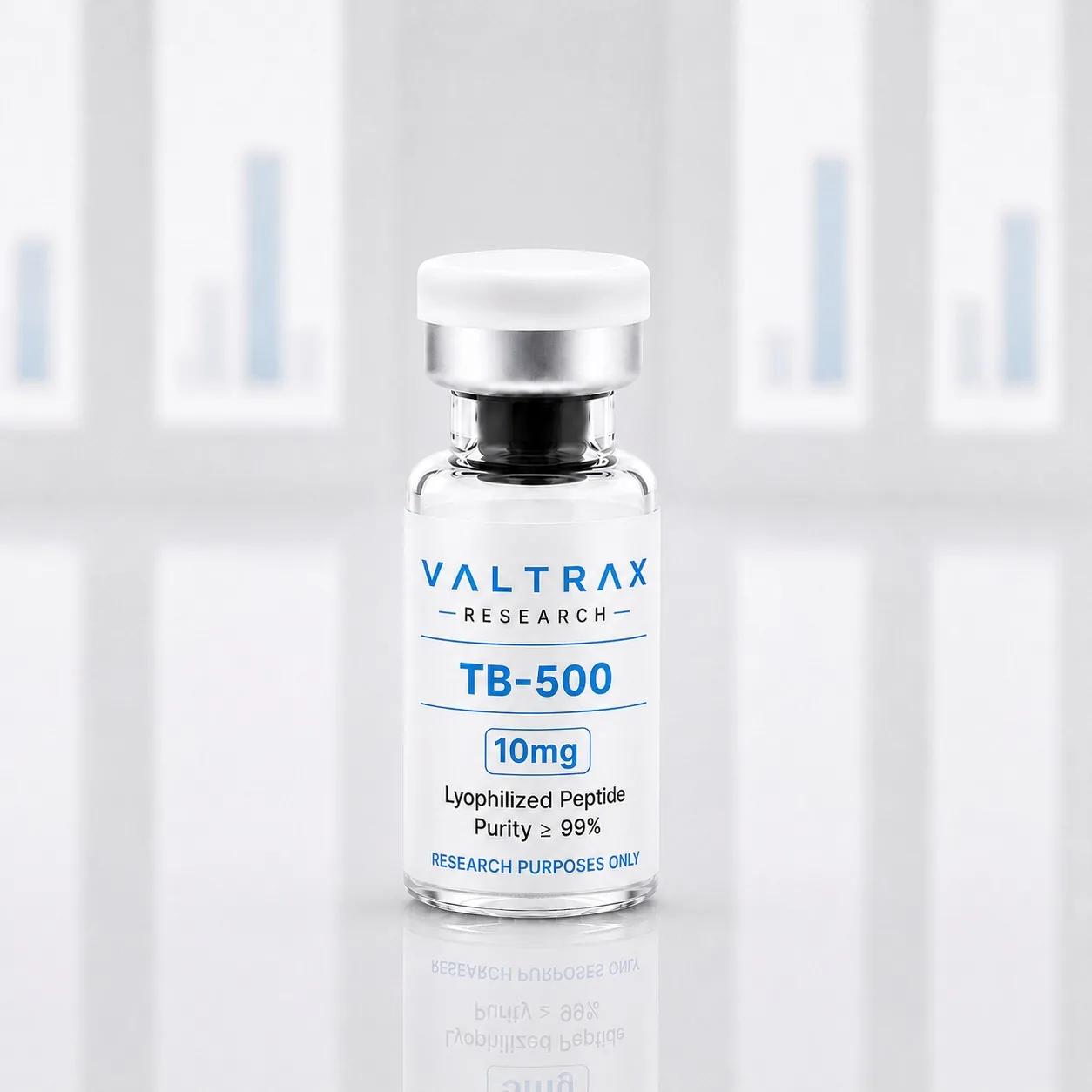
$60.00
10mg
Thymosin Beta-4 fragment. A 43-amino acid synthetic peptide. Supplied as a lyophilized powder for research purposes only.
Tissue Repair & Cytoprotection
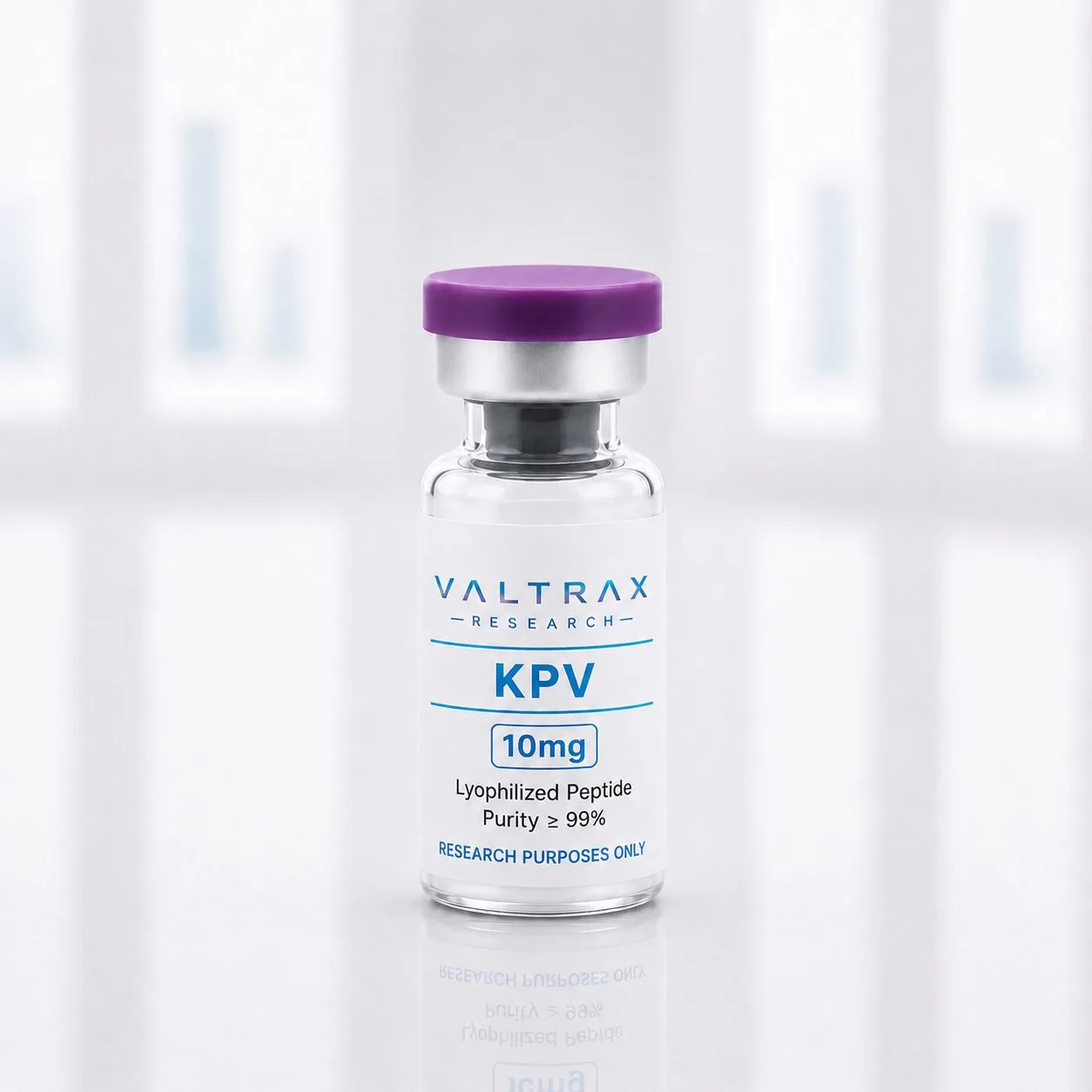
$80.00
10mg
Lys-Pro-Val, the alpha-MSH(11–13) tail that keeps the anti-inflammatory signal without the pigmentation activity. Supplied as a lyophilized powder for research purposes only.