Cart
Your cart is empty
Find
Tripeptide · α-MSH(11–13) fragment
Lys-Pro-Val, the alpha-MSH(11–13) tail that keeps the anti-inflammatory signal without the pigmentation activity. Supplied as a lyophilized powder for research purposes only.
Launch Sale · Ends Nov 6
Get an email when it restocks
One email the moment it can be ordered — plus sale pricing and new journal entries on KPV.
Tested lot by lot at ≥99% purity. The Janoshik certificate for your lot is emailed with the order.
Everything Valtrax Research ships is bench material for in-vitro work. None of it is a drug, a supplement, a cosmetic, or a medical device, and none of it is intended for human or animal use, ingestion, or administration. Placing an order is your confirmation that you are a qualified researcher buying for lawful research, under every Canadian law and regulation that applies to you.
Lys-Pro-Val. The last three residues of α-MSH, and a clean separation of function. Cut the hormone to this tail and the pigmentation activity is gone, but the anti-inflammatory action holds. Studying that residual signal on its own is the point of the fragment.
Three residues also means small enough to use PepT1, the intestinal di/tripeptide transporter, as a way in. The tripeptide is carried straight into epithelial cells — which is why the bench record concentrates on the gut wall and the cytokine output around it rather than on systemic distribution.
Intestinal inflammation is the anchor. Dalmasso fixed two things at once — PepT1 as the uptake route and a measurable drop in colonic inflammatory markers — and the work since has loaded the tripeptide onto targeted carriers, reading colitis severity, cytokine levels, and barrier integrity as the endpoints.
What KPV retains from α-MSH is the anti-inflammatory half, minus the melanocortin-receptor activity — and the literature follows that retained signal into the intestine. Dalmasso mapped the entry route through PepT1 and recorded a fall in colonic inflammation; the targeted-carrier studies that came after were built on top of that finding.
Three readouts recur: NF-κB tone, pro-inflammatory cytokine levels, and epithelial barrier behaviour. Across them the fragment is treated as a compact, transporter-accessible brake applied directly at the gut wall.
It traces to the dissection of α-MSH. With the melanocortin peptides mapped, the open question was which segment carried the anti-inflammatory action without dragging the pigmentary one along — and the answer was the C-terminal Lys-Pro-Val.
The intestinal chapter came later and gave the fragment its working context. PepT1-mediated transport handed KPV a defined route into epithelial cells, and colitis preparations became the models where it was characterized.
In vitro and animal studies
KPV is the C-terminal tripeptide of alpha-melanocyte-stimulating hormone â lysine-proline-valine, three residues. Despite its size it retains a substantial part of the anti-inflammatory activity of the parent hormone while lacking the pigmentary effect, which is what makes it interesting as a research tool: it separates two functions that are combined in alpha-MSH.
The best-developed preclinical literature is gastrointestinal. In murine colitis models, including DSS-induced and TNBS-induced colitis, orally administered KPV has been reported to reduce inflammatory markers, limit histological damage and improve weight-loss endpoints. Work from Georgia State University and collaborators described uptake via the PepT1 transporter expressed on intestinal epithelial and immune cells, providing a plausible route by which an orally delivered tripeptide reaches its site of action â an unusual property, since most peptides are degraded before absorption.
Mechanistically, published work reports inhibition of NF-κB and MAPK signalling and reduced production of pro-inflammatory cytokines. A separate smaller literature covers antimicrobial activity against organisms including Candida albicans and Staphylococcus aureus, and topical work on skin inflammation.
The transport mechanism deserves particular attention because it is what makes this compound unusual. PepT1 is a proton-coupled oligopeptide transporter that carries di- and tripeptides across the intestinal epithelium, and it is essentially the only route by which an intact tripeptide reaches systemic circulation after oral administration. KPV is a substrate for it.
What makes that pharmacologically interesting is that PepT1 expression is itself altered in inflamed intestinal tissue, and it is expressed on immune cells within the mucosa as well as on enterocytes. A compound taken up preferentially at the site where it acts, by a transporter upregulated in the disease state being modelled, is an elegant arrangement — and one whose relevance to human intestinal tissue, where PepT1 expression patterns differ from mouse, has not been established.
Human data, where it exists
No controlled human trials of KPV have been published for inflammatory bowel disease, skin inflammation or any other indication. The compound has not been through the pharmacokinetic characterisation that would allow an animal dose to be interpreted in human terms, and no human safety dataset exists.
The parent hormone alpha-MSH and related melanocortin pathways have been studied clinically in other contexts, and melanocortin agonists are an active area of drug development. That work does not constitute evidence for KPV specifically. A tripeptide fragment with the pigmentary activity deliberately removed is pharmacologically distinct from the full hormone, which is precisely the point of studying it.
Common assertions, and what the record supports
KPV is commonly presented as a gut-healing and anti-inflammatory agent effective by mouth. The oral part of that claim is better supported than for most peptides — the PepT1 uptake mechanism is real, documented, and explains how a tripeptide survives to act in the intestine. That is a genuine strength of the evidence base.
What remains unsupported is the human step. All of the efficacy data comes from induced colitis in mice, a model that reproduces some features of human inflammatory bowel disease and not others, and which has a long history of producing agents that fail to translate. Reported effect sizes in that model should not be read as expected human effect sizes.
Claims that KPV is "just a part of a natural hormone" and therefore inherently safe do not follow. Fragments frequently have activity profiles unlike their parent molecules — that is the reason this fragment is studied at all.
Against the compounds it is most often confused with
KPV is best understood against its parent hormone. Alpha-MSH combines anti-inflammatory activity with pigmentary activity through MC1R; KPV retains a substantial part of the former while shedding the latter. That separation is the entire reason the fragment is studied — it isolates one arm of a hormone that otherwise does two things at once. Melanotan II, also in this catalogue, sits at the opposite end of the same system: a non-selective melanocortin agonist whose primary documented action is precisely the pigmentary one KPV lacks.
Against BPC-157 and TB-500, KPV addresses a different problem. Those two are studied for rebuilding damaged tissue — vasculature and cell migration respectively. KPV is studied for reducing the inflammatory signalling that accompanies damage. In colitis models the endpoints measured are cytokine output and histological inflammation, not tensile strength or vessel density.
Its oral bioavailability through PepT1 is genuinely unusual and separates it from nearly every other peptide here.
Adverse findings, toxicology gaps, material hazards
The specific toxicology of KPV has not been characterised in humans, and chronic-exposure animal data is limited. Because the compound acts on inflammatory signalling, the theoretical concern is the one that applies to any anti-inflammatory: suppression of responses that exist for a reason, including antimicrobial defence. The published antimicrobial findings complicate rather than resolve that question.
Melanocortin receptor pharmacology is complex and tissue-dependent. KPV is generally described as acting through pathways that do not require MC1R binding, but its interaction profile across the melanocortin system has not been fully mapped.
Materially, a three-residue peptide is trivially cheap to synthesize, and short peptides are among the items where supplier quality varies most and where identity confirmation is most worth having. Purity by RP-HPLC alone is insufficient for a tripeptide; mass-spectrometric identity confirmation is the meaningful check.
Bench practice for this compound
KPV is small, stable relative to longer sequences, and dissolves quickly. Reconstitute with bacteriostatic water against the vial wall and swirl gently. Short peptides tolerate handling better than large ones but are not immune to foaming losses.
Store reconstituted material at 2–8 °C away from light; keep unopened lyophilized powder frozen for long-term storage. Aliquot before freezing rather than cycling a single vial through repeated thaws.
This summary describes published research. It is not a protocol, not a recommendation, and not a statement that this compound is safe or effective for any use. Not for human or animal use.
Xiao, B. et al. (2017). Orally targeted delivery of tripeptide KPV via hyaluronic acid-functionalized nanoparticles efficiently alleviates ulcerative colitis.
PubMedLaroui, H. et al. (2010). Drug-loaded nanoparticles targeted to the colon with polysaccharide hydrogel reduce colitis in a mouse model.
PubMedDalmasso, G. et al. (2008). PepT1-mediated tripeptide KPV uptake reduces intestinal inflammation.
PubMedEvery lot is tested for identity, purity, and net content.
Janoshik Analytical, a laboratory Valtrax does not own, runs the testing — identity by mass spectrometry, purity by RP-HPLC at ≥99%, on the lot you receive.
Same Shelf
Tissue Repair & Cytoprotection
$56.00
$70.00
10mg
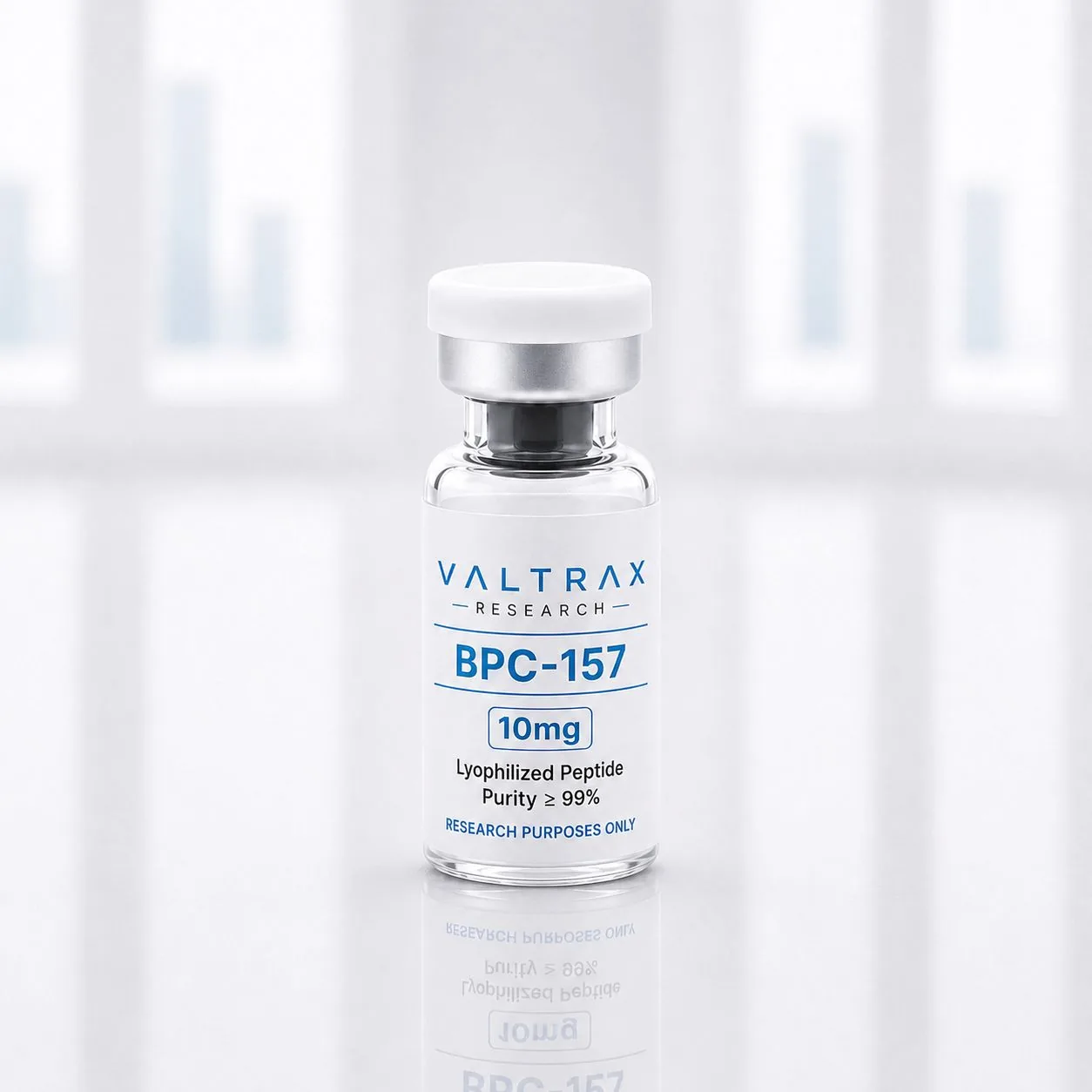
Body Protection Compound-157. A 15-amino-acid peptide studied in experimental models of structural repair and angiogenic pathway regulation.
Tissue Repair & Cytoprotection
$48.00
$60.00
10mg
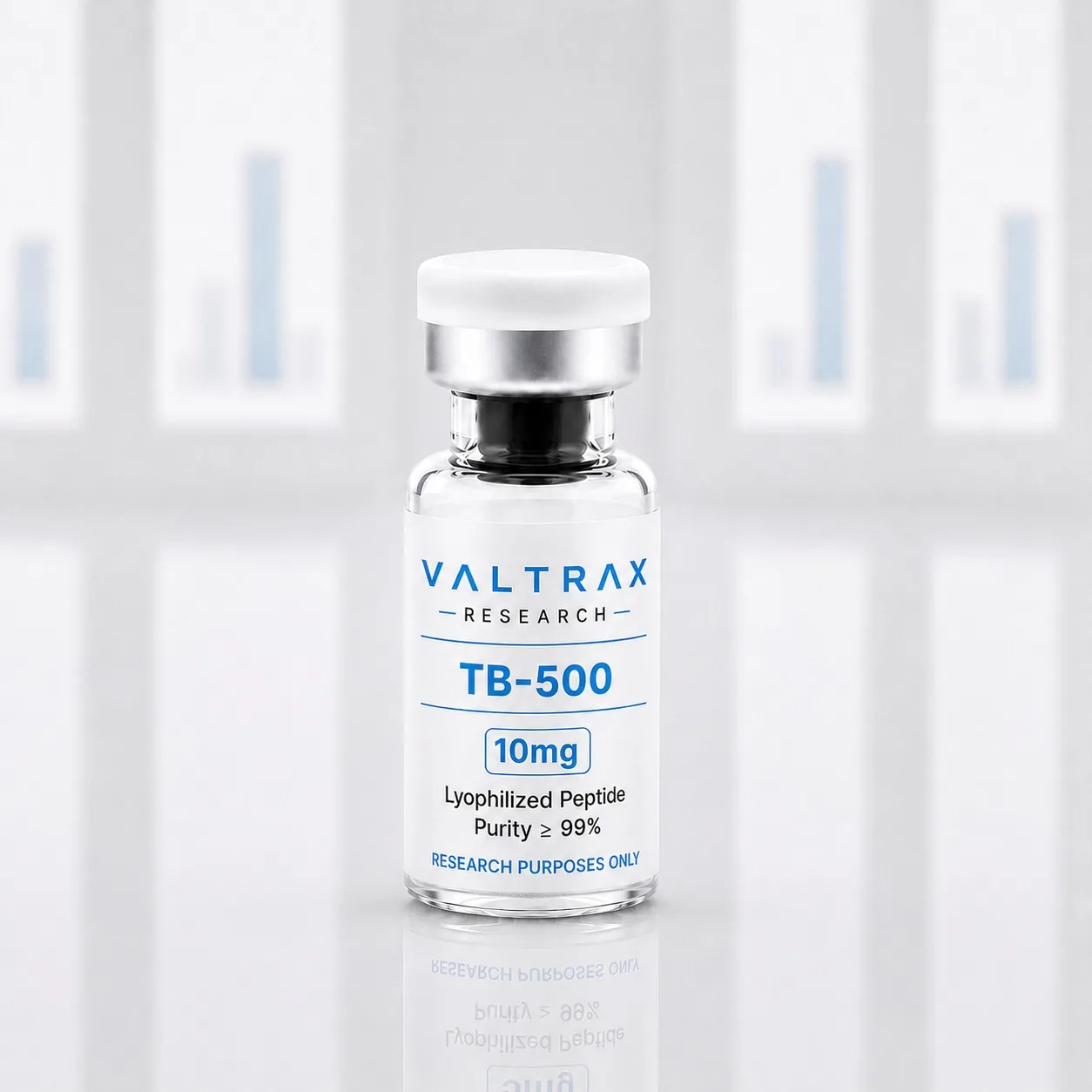
Thymosin Beta-4 fragment. A 43-amino acid synthetic peptide. Supplied as a lyophilized powder for research purposes only.