Cart
Your cart is empty
Find
Four-peptide repair stack · GHK-Cu / BPC-157 / TB-500 / KPV
A four-peptide repair stack — GHK-Cu, BPC-157, TB-500 and KPV — in one fill. Supplied as a lyophilized powder for research purposes only.
Launch Sale · Ends Nov 6
Tested lot by lot at ≥99% purity. The Janoshik certificate for your lot is emailed with the order.
Everything Valtrax Research ships is bench material for in-vitro work. None of it is a drug, a supplement, a cosmetic, or a medical device, and none of it is intended for human or animal use, ingestion, or administration. Placing an order is your confirmation that you are a qualified researcher buying for lawful research, under every Canadian law and regulation that applies to you.
Four peptides in one fill, picked because they touch tissue repair at four separate points. GHK-Cu carries copper and moves matrix genes. BPC-157, the gastric pentadecapeptide, works angiogenesis and the nitric-oxide axis. TB-500, a thymosin β4 fragment, sequesters actin and drives migration. KPV, the tail end of α-MSH, brings the anti-inflammatory signal.
Four mechanisms, four lineages, one vial. The reason to co-formulate rather than run four parallel preparations is to read whether those distinct effects show up together in the same tissue model — matrix, vascular, cytoskeletal, and immune, side by side.
Everything published sits at the single-peptide level: GHK-Cu on matrix genes and wound models, BPC-157 across tendon and gut repair, thymosin β4 / TB-500 on migration and closure, KPV on PepT1 uptake and colitis. The combination itself is the open part — whether matrix, vascular, cytoskeletal, and immune effects layer in a shared tissue-response model is the question the blend exists to put on the bench.
Read the four references and you get four distinct literatures. GHK-Cu: copper transport and the skin-regeneration gene programs Pickart mapped. BPC-157: angiogenesis and tendon/gut repair. TB-500: actin sequestration and wound closure. KPV: PepT1 uptake and a brake on colonic inflammation. KLOW is the point where those four records sit in a single tube.
The stack does not add a new mechanism — it tests an interaction. Put together, does the matrix, vascular, cytoskeletal, and immune work read additively in one model, or does the combination behave unlike the sum of four separate runs? That question is the reason to co-formulate.
No shared origin holds these four together — they were assembled, not discovered as a group. Pickart pulled GHK from human plasma in the 1970s and later connected the copper complex to skin-regeneration genes. BPC-157 emerged from gastric-juice screening; TB-500 from thymosin β4 cytoskeletal research; KPV from the hunt for the active piece of α-MSH.
Bringing them into one preparation is a deliberate convenience: a single controlled experiment that carries all four mechanistic stories at once, instead of four experiments run apart.
In vitro and animal studies
KLOW is built on the same premise as GLOW — GHK-Cu combined with repair peptides — with the addition of KPV, which contributes an inflammatory arm the other preparation lacks.
GHK-Cu is the anchor: a copper-binding tripeptide with a research record dating to the 1970s, reported in fibroblast culture to increase synthesis of collagen, elastin, glycosaminoglycans and proteoglycans, and to modulate matrix metalloproteinases and their inhibitors.
KPV is the C-terminal tripeptide of alpha-melanocyte-stimulating hormone. It retains a substantial part of the parent hormone's anti-inflammatory activity while lacking its pigmentary effect, and its published mechanism includes inhibition of NF-κB and MAPK signalling with reduced pro-inflammatory cytokine output. Its best-developed literature is in murine colitis, with additional work on skin inflammation and antimicrobial activity.
The repair peptides supply angiogenesis and cell migration. Matrix synthesis, inflammatory control, blood supply and cell movement are four distinct requirements — the rationale for a four-way combination. No published study examines this formulation.
Human data, where it exists
No controlled human trials of this preparation exist. As with the other blends, the honest position has to be stated at the level of the formulation rather than the components.
GHK-Cu is the only component with meaningful human data, and it is topical: dermatological studies of copper peptide creams reporting improvements in skin density, elasticity and photodamage, delivered locally to the dermis.
KPV has no controlled human trials for any indication. Its evidence is entirely preclinical, largely induced colitis in mice. BPC-157 and TB-500 have no controlled human trial evidence for the endpoints this preparation is marketed around.
No human pharmacokinetic data exists for any of these components in this combination, and no study has characterised interactions among four peptides administered together. Combining components does not average their evidentiary weakness; it multiplies the number of uncharacterised variables.
Common assertions, and what the record supports
The claim that KLOW is a more complete version of GLOW because it adds an anti-inflammatory component is coherent as a rationale. Inflammatory signalling is genuinely part of tissue remodelling, and KPV's mechanism is real and documented in animal models.
What this does not establish is that adding a fourth peptide improves outcomes. Each addition increases the number of mechanisms in play and, simultaneously, the difficulty of attributing any result to any of them. More components is not more evidence.
The route problem carries over from GLOW. The human evidence for GHK-Cu is topical, and it is used to support systemic administration of a blend, which the local mechanism argues against.
And the attribution limit is at its most severe here. With four active components in a fixed ratio, an observed effect cannot be assigned, an absent effect cannot be diagnosed, and no component can be varied independently.
Against the compounds it is most often confused with
Against GLOW, the difference is KPV — an anti-inflammatory arm through alpha-MSH fragment activity. Whether that is an improvement depends entirely on whether inflammatory signalling is the limiting factor in the process being studied, which is not knowable from within a fixed blend. Exact component content for both is on the respective product pages.
Against the individual compounds sold separately, the trade-off is at its steepest: four mechanisms in one vial against complete loss of experimental resolution.
Against the BPC-157/TB-500 blend, this is the more complex preparation and the more cosmetically oriented one, anchored on matrix synthesis rather than structural repair.
Against KPV sold alone, the single compound isolates the inflammatory mechanism, which is what any experiment examining that mechanism specifically would require.
Adverse findings, toxicology gaps, material hazards
Copper is the component-specific risk, as in GLOW. GHK-Cu delivers copper, which has a narrow window between sufficiency and toxicity; systemic accumulation causes gastrointestinal effects, hepatic injury and, in severe cases, haemolysis and neurological effects. Wilson disease and other copper-handling disorders make this considerably more dangerous. No human safety data exists for repeated systemic administration of a copper complex.
KPV acts on inflammatory signalling, and suppressing inflammatory responses has consequences including effects on antimicrobial defence. Its interaction profile across the melanocortin system is not fully mapped.
The angiogenic and migratory components carry the concern attaching to systemic promotion of growth-supporting processes.
The four-component composition is the risk multiplier. Verifying that four peptides are present in the stated ratio at stated purity is a demanding analytical task, and interactions among them are entirely uncharacterised. Independent lot-specific testing matters more here than for any other format in this catalogue.
Bench practice for this compound
The GHK-Cu content gives this preparation a blue colour that serves as a stability indicator — loss or change of colour suggests the copper complex has dissociated or degraded.
Reconstitute with bacteriostatic water directed against the vial wall rather than onto the powder cake, swirling gently until dissolved. Do not shake. Protect from light and avoid contact with strong chelating or reducing agents, which will strip the copper.
Store reconstituted material at 2–8 °C in the dark and observe the working window on this page. Component ratios are fixed at manufacture, so concentration calculations apply to the preparation as a whole rather than to individual peptides. Keep unopened lyophilized vials frozen for long-term storage and avoid freeze-thaw cycling.
This summary describes published research. It is not a protocol, not a recommendation, and not a statement that this compound is safe or effective for any use. Not for human or animal use.
Pickart, L. et al. (2015). GHK peptide as a natural modulator of multiple cellular pathways in skin regeneration.
PubMedSikiric, P. et al. (1993). A new gastric juice peptide, BPC. An overview of the stomach-stress-organoprotection hypothesis and beneficial effects of BPC. J Physiol Paris 87(5):313–327.
PubMedGoldstein, A.L. et al. (2012). Thymosin β4: a multi-functional regenerative peptide. Basic properties and clinical applications. Expert Opin Biol Ther 12(1):37–51.
PubMedChang, C.H. et al. (2011). The promoting effect of pentadecapeptide BPC 157 on tendon healing involves tendon outgrowth, cell survival, and cell migration. J Appl Physiol (1985) 110(3):774–780.
PubMedChang, C.H. et al. (2014). Pentadecapeptide BPC 157 enhances the growth hormone receptor expression in tendon fibroblasts. Molecules 19(11):19066–19077.
PubMedDalmasso, G. et al. (2008). PepT1-mediated tripeptide KPV uptake reduces intestinal inflammation. Gastroenterology 134(1):166–178.
PubMedKolovrat, M. et al. (2020). Pentadecapeptide BPC 157 resolves Pringle maneuver in rats, both ischemia and reperfusion. World J Hepatol 12(5):184–206.
PubMedIndependent testing lot by lot: identity, purity, net content.
Janoshik Analytical, a laboratory Valtrax does not own, runs the testing — identity by mass spectrometry, purity by RP-HPLC at ≥99%, on the lot you receive.
Same Shelf
Skin & Cosmetic
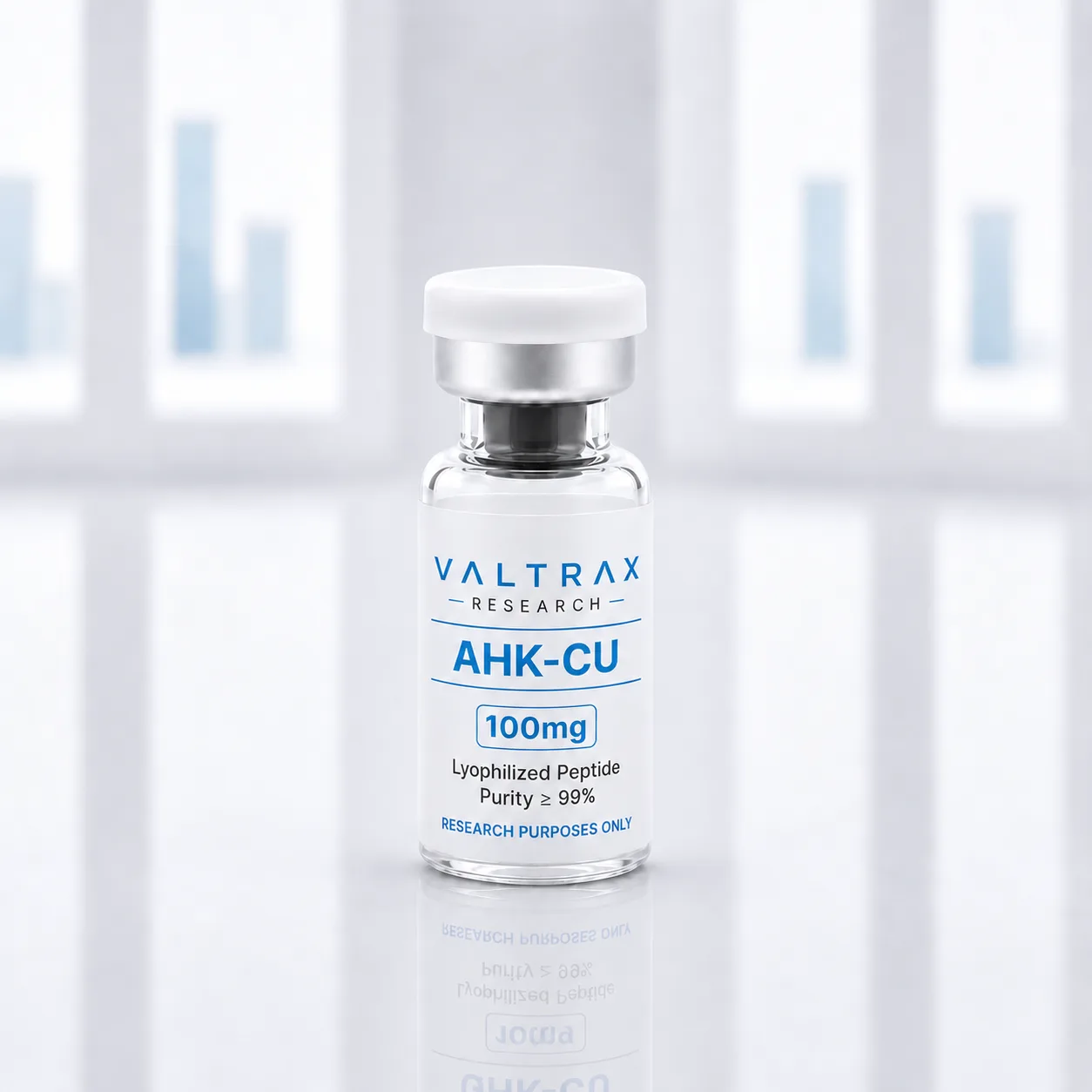
$80.00
$100.00
100mg