Cart
Your cart is empty
Find
Two-peptide repair stack · 1:1
Also known as Wolverine Blend
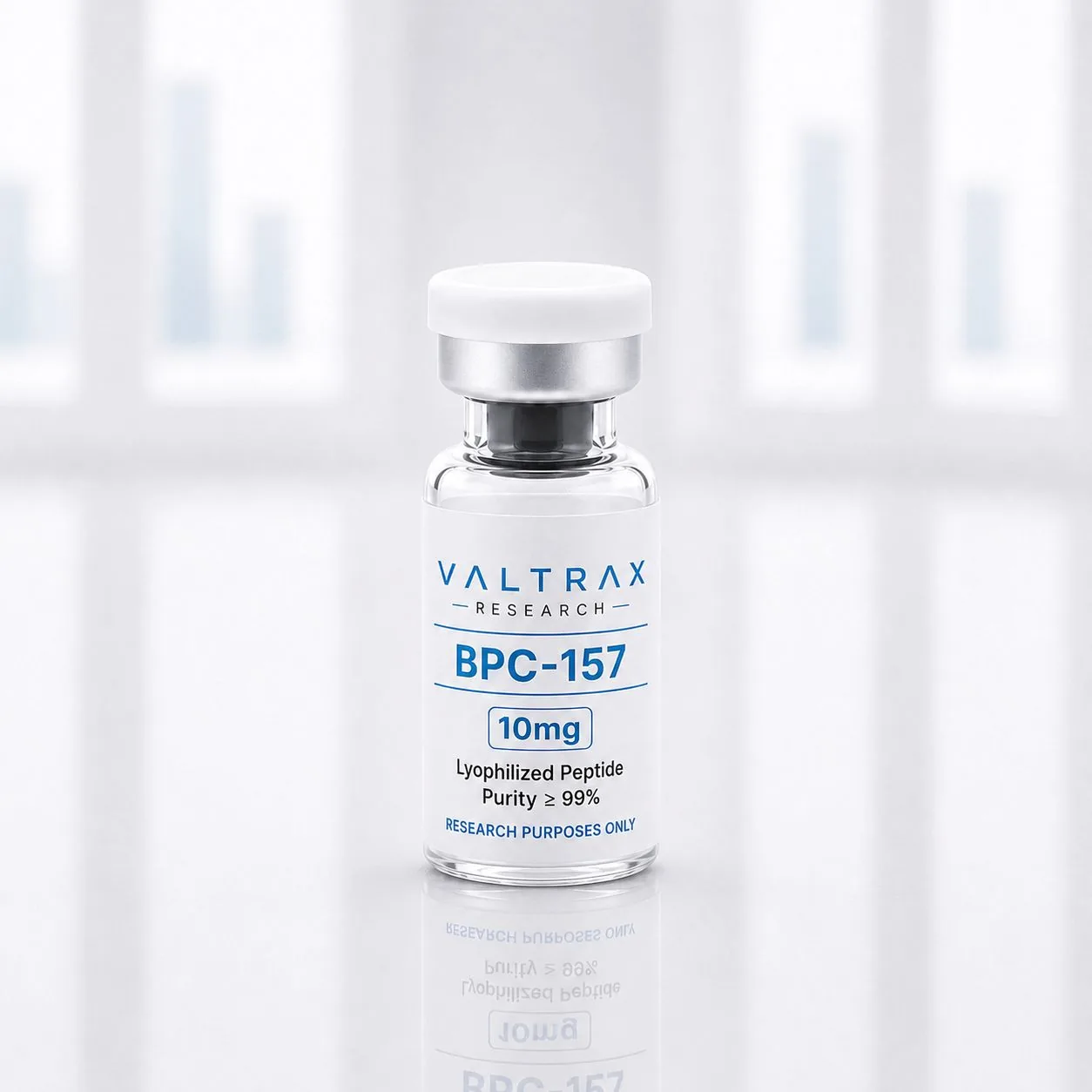
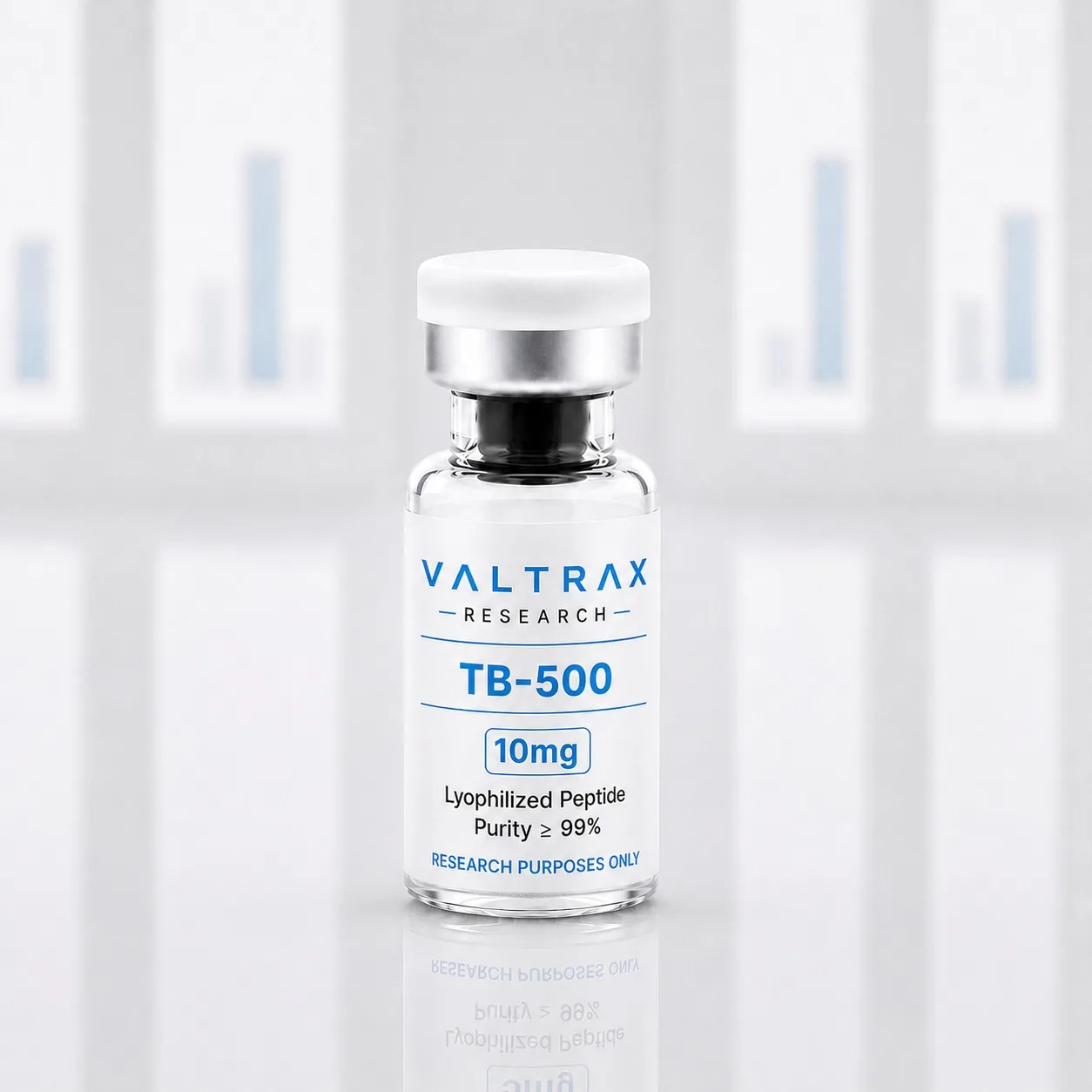
One vial, two repair peptides at equal load: BPC-157 and TB-500. Supplied as a lyophilized powder for research purposes only.
Launch Sale · Ends Nov 6
Tested lot by lot at ≥99% purity. The Janoshik certificate for your lot is emailed with the order.
Everything Valtrax Research ships is bench material for in-vitro work. None of it is a drug, a supplement, a cosmetic, or a medical device, and none of it is intended for human or animal use, ingestion, or administration. Placing an order is your confirmation that you are a qualified researcher buying for lawful research, under every Canadian law and regulation that applies to you.
One vial, two compounds at equal load: BPC-157 and TB-500. The pairing exists because the peptides work repair from different angles — BPC-157 on angiogenesis and the nitric-oxide axis, TB-500 (a thymosin β4 fragment) on actin binding and cell migration.
Set side by side, they let a single preparation probe both the vascular and the cytoskeletal sides of tissue response. That complementary mechanism is the reason the blend is handled as one unit rather than as two separate vials.
The published basis is each peptide on its own: BPC-157 across tendon, vascular, and gut-repair preparations; thymosin β4 / TB-500 across wound closure, epicardial mobilization, and venous-ulcer studies. The blend layer asks whether their angiogenic and cytoskeletal effects read additively in shared models.
Each peptide carries its own literature before they ever share a vial. BPC-157 reads through angiogenesis and connective-tissue models; TB-500, the thymosin β4 fragment, reads through actin regulation and cell migration. The blend is the place those two records overlap.
Studied together, the formulation lets a lab watch vascular and cytoskeletal responses in the same preparation instead of running them apart — the point of co-formulating rather than dosing two vials in parallel.
BPC-157 traces to gastric-peptide screening in the early 1990s. TB-500 comes from a separate line entirely — the thymosin β4 work on cytoskeletal dynamics and wound response.
Combining them was a research convenience: a single 1:1 preparation that brings both mechanistic stories into one controlled experiment.
In vitro and animal studies
This preparation combines two peptides whose repair literatures developed separately and whose mechanisms do not overlap — which is the entire stated rationale for pairing them.
BPC-157 is a fifteen-residue sequence derived from a protein found in gastric juice. Its rodent literature spans tendon, ligament, muscle and gastrointestinal injury models, and the mechanism most consistently reported is angiogenic: upregulation of VEGFR2 with downstream Akt-eNOS signalling, producing increased vessel formation in the healing field, alongside a documented interaction with nitric oxide signalling.
TB-500 corresponds to the actin-binding region of thymosin beta-4. It sequesters G-actin monomers, regulating the pool available for polymerisation and therefore governing cytoskeletal remodelling and cell migration. Its preclinical record covers dermal and corneal wound closure and cardiac models.
Vasculature and cell movement are genuinely different requirements of tissue repair, and studies that combine the two cite exactly that complementarity. What the literature does not contain is much rigorous work on the combination itself as distinct from its parts.
Human data, where it exists
Neither component has controlled human trial evidence for the musculoskeletal repair uses this preparation is marketed around, and the combination has none at all.
BPC-157 has no completed published controlled human trials for tendon, ligament or gastrointestinal healing. Full-length thymosin beta-4 did reach human trials in ophthalmology, but those used the native 43-residue protein delivered topically to the eye — not the injected synthetic fragment sold as TB-500, and not for musculoskeletal injury.
No human pharmacokinetic data exists for either component at these exposures, and no study has characterised whether the two interact pharmacologically when administered together. Both compounds appear on the World Anti-Doping Agency Prohibited List.
The evidentiary position is therefore weaker than for either component alone, because combining two compounds without human data does not average their uncertainty — it compounds it.
Common assertions, and what the record supports
The claim that BPC-157 and TB-500 work synergistically is the central selling point and it is partly reasonable. Two agents acting on non-overlapping mechanisms toward one endpoint is a coherent rationale, and it is the reason the literature pairs them.
What has not been demonstrated is synergy itself, in the technical sense of a combined effect exceeding the sum of the parts. Very few studies have tested the combination against each component separately with adequate design, and asserting synergy requires exactly that comparison. Complementary mechanisms make synergy plausible; they do not establish it.
The more consequential issue is attribution, and it applies regardless of whether the compounds work. A fixed-ratio blend cannot tell you which component produced an observed result, whether one was inert, or whether the ratio was appropriate. For a protocol that needs a clean independent variable, a blend is the wrong tool — a limitation of the format rather than of the compounds.
Against the compounds it is most often confused with
Against the single compounds sold separately in this catalogue, the trade-off is convenience against experimental resolution. One vial and one reconstitution is simpler; a fixed ratio set at manufacture removes the ability to vary components independently, which is usually the thing an experiment most needs to do.
Against the GLOW and KLOW preparations, the difference is subject area. This blend targets structural repair through angiogenesis and cell migration. Those are built around GHK-Cu and address dermal matrix synthesis, with repair peptides supporting the vascular and migratory side.
Against the growth hormone secretagogues, the contrast is local versus systemic. CJC-1295 and ipamorelin act on an endocrine axis, raising GH and IGF-1 body-wide. These two act on tissue-level repair processes without engaging the GH axis.
Adverse findings, toxicology gaps, material hazards
Every risk attaching to the individual components applies here, and the fixed ratio removes the ability to adjust one without the other.
Both compounds promote angiogenesis or cell migration, and both mechanisms support the growth and spread of tissue that should not be supported. Thymosin beta-4 has been reported as upregulated in several tumour types with associations to invasiveness in cell models. No study demonstrates that either compound causes malignancy; none adequately excludes an effect on existing disease, and combining two agents that act on those processes does not reduce that concern.
Chronic toxicology has not been characterised for either component in any species at these durations, and the combination has never been studied for interaction.
Materially, a multi-component vial is harder to verify than a single compound. Confirming that both peptides are present, in the stated ratio, at the stated purity, is a more demanding analytical task, and it is the reason lot-specific third-party testing matters more here than usual.
Bench practice for this compound
Reconstitution follows the same rules as for either compound alone, with the constraint that both components share one vial and one solvent volume. Direct bacteriostatic water against the vial wall rather than onto the powder cake, and swirl gently until dissolved — never shake.
Because the ratio is fixed at manufacture, concentration calculations apply to the preparation as a whole; the individual component quantities are given on this product page. Store reconstituted material at 2–8 °C protected from light, observe the working window, and keep unopened lyophilized vials frozen for long-term storage. Avoid freeze-thaw cycling.
This summary describes published research. It is not a protocol, not a recommendation, and not a statement that this compound is safe or effective for any use. Not for human or animal use.
Staresinic, M. et al. (2003). Gastric pentadecapeptide BPC 157 accelerates healing of transected rat Achilles tendon and in vitro stimulates tendocytes growth.
PubMedChang, C.H. et al. (2011). The promoting effect of pentadecapeptide BPC 157 on tendon healing involves tendon outgrowth, cell survival, and cell migration. J Appl Physiol (1985) 110(3):774–780.
PubMedSikiric, P. et al. (2012). Focus on ulcerative colitis: stable gastric pentadecapeptide BPC 157. Curr Med Chem 19(1):126–132.
PubMedMalinda, K.M. et al. (1999). Thymosin beta4 accelerates wound healing.
PubMedSmart, N. et al. (2007). Thymosin beta4 induces adult epicardial progenitor mobilization and neovascularization.
PubMedGuarnera, G. et al. (2010). The effect of thymosin treatment of venous ulcers.
PubMedJanoshik Analytical measures identity, purity, and net content, lot by lot.
Janoshik Analytical, a laboratory Valtrax does not own, runs the testing — identity by mass spectrometry, purity by RP-HPLC at ≥99%, on the lot you receive.
Same Shelf