Cart
Your cart is empty
Find
Nonapeptide · named for an EEG band
DSIP is a synthetic nonapeptide (delta sleep-inducing peptide) is a synthetic nine-amino-acid peptide first isolated from rabbit brain. It is studied in preclinical research for its interaction with hypothalamic and circadian signaling pathways.
Launch Sale · Ends Nov 6
Get an email when it restocks
One email the moment it can be ordered — plus sale pricing and new journal entries on DSIP.
Tested lot by lot at ≥99% purity. The Janoshik certificate for your lot is emailed with the order.
Everything Valtrax Research ships is bench material for in-vitro work. None of it is a drug, a supplement, a cosmetic, or a medical device, and none of it is intended for human or animal use, ingestion, or administration. Placing an order is your confirmation that you are a qualified researcher buying for lawful research, under every Canadian law and regulation that applies to you.
Trp-Ala-Gly-Gly-Asp-Ala-Ser-Gly-Glu — nine residues, and a name that points at an observation rather than a target. DSIP was first recovered from rabbit cerebral venous blood drawn during delta-band sleep, and it carries the EEG signature in its title because that is all the early work could pin to it.
Fifty years later the receptor is still unnamed. That gap is the draw: the peptide turns up in circadian and stress-axis studies not as a solved mechanism but as a recurring loose end the field keeps pulling on.
Two strands run through the record — slow-wave sleep and the stress axis — and a single caveat undercuts both: no assigned receptor, plus clearance fast enough to complicate dosing logic in any model. The result is a literature that mostly reports what DSIP travels with rather than how it acts.
Reported in the mid-1970s, DSIP entered the record through sleep electrophysiology — isolated by its association with slow-wave EEG, then sequenced and made synthetically to confirm the activity survived synthesis. The title encodes that history; it does not encode a pathway.
What the literature actually circles is timing. Studies read DSIP against circadian rhythm and the hypothalamic–pituitary axis, and read it as a correlate more than a cause. The half-life is short, the receptor unassigned, and the picture stays deliberately open.
The starting point was a perfusate: cerebral venous blood collected from rabbits in delta sleep, fractionated until a nine-residue fraction carried the signal. Monnier’s group then ran the synthetic nonapeptide back through the test to check the activity held. Sleep physiology framed the first wave of models.
After that the subject widened — stress reactivity, rhythm entrainment, endocrine cross-talk — without ever resolving onto a single mechanism. DSIP has stayed in the literature precisely as an unsettled case rather than a closed one.
A structured evidence summary for this item is still being written. The primary literature listed under Molecule is the starting point in the meantime.
Monnier, M. et al. (1977). The delta sleep inducing peptide (DSIP). Comparative properties of the original and synthetic nonapeptide.
PubMedSchoenenberger, G.A. et al. (1978). The delta EEG (sleep)-inducing peptide (DSIP). XI. Amino-acid analysis, sequence, synthesis and activity of the nonapeptide. Pflugers Arch 376(2):119–129.
PubMedSchneider-Helmert, D. et al. (1981). Acute and delayed effects of DSIP (delta sleep-inducing peptide) on human sleep behavior. Int J Clin Pharmacol Ther Toxicol 19(8):341–345.
PubMedSchneider-Helmert, D. & Schoenenberger, G.A. (1981). The influence of synthetic DSIP (delta-sleep-inducing-peptide) on disturbed human sleep.
PubMedGraf, M.V. & Kastin, A.J. (1984). Delta-sleep-inducing peptide (DSIP): a review.
PubMedSchoenenberger, G.A. (1984). Characterization, properties and multivariate functions of delta-sleep-inducing peptide (DSIP).
PubMedGraf, M.V. & Kastin, A.J. (1986). Delta-sleep-inducing peptide (DSIP): an update.
PubMedSchneider-Helmert, D. et al. (1987). Effects of delta-sleep-inducing peptide on 24-hour sleep-wake behaviour in severe chronic insomnia. Eur Neurol 27(2):120–129.
PubMedPollard, B.J. & Pomfrett, C.J.D. (2001). Delta sleep-inducing peptide.
PubMedKovalzon, V.M. (2006). Delta sleep-inducing peptide (DSIP): a still unresolved riddle.
PubMedThe certificate for your lot reports measured identity, purity, and net content, and is sent by email.
Janoshik Analytical, a laboratory Valtrax does not own, runs the testing — identity by mass spectrometry, purity by RP-HPLC at ≥99%, on the lot you receive.
Same Shelf
Nootropic & Neuromodulatory
$48.00
$60.00
10mg
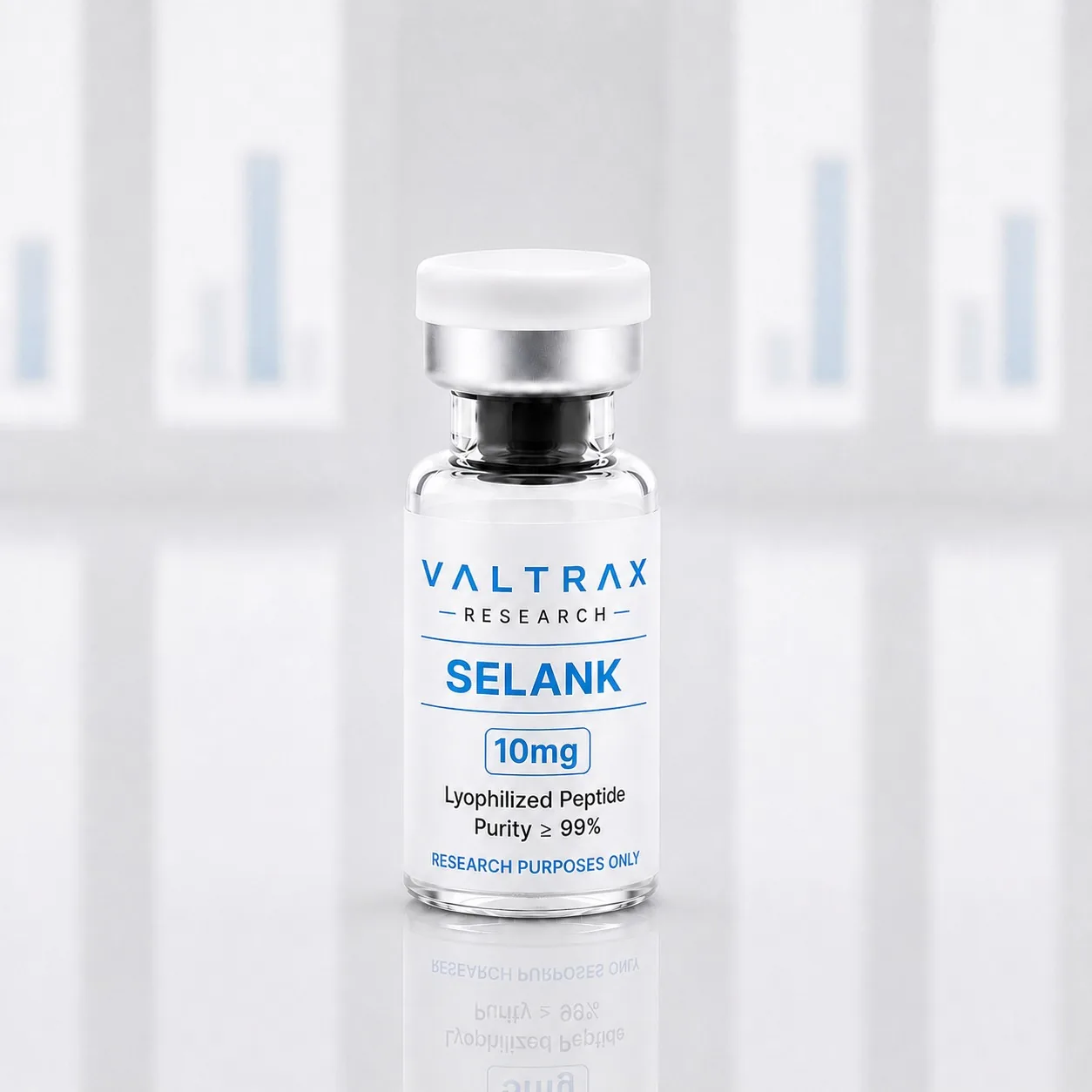
A tuftsin-derived heptapeptide (Thr-Lys-Pro-Arg-Pro-Gly-Pro) stabilized by a Pro-Gly-Pro tail. Supplied as a lyophilized powder for research purposes only.
Nootropic & Neuromodulatory
$48.00
$60.00
5mg
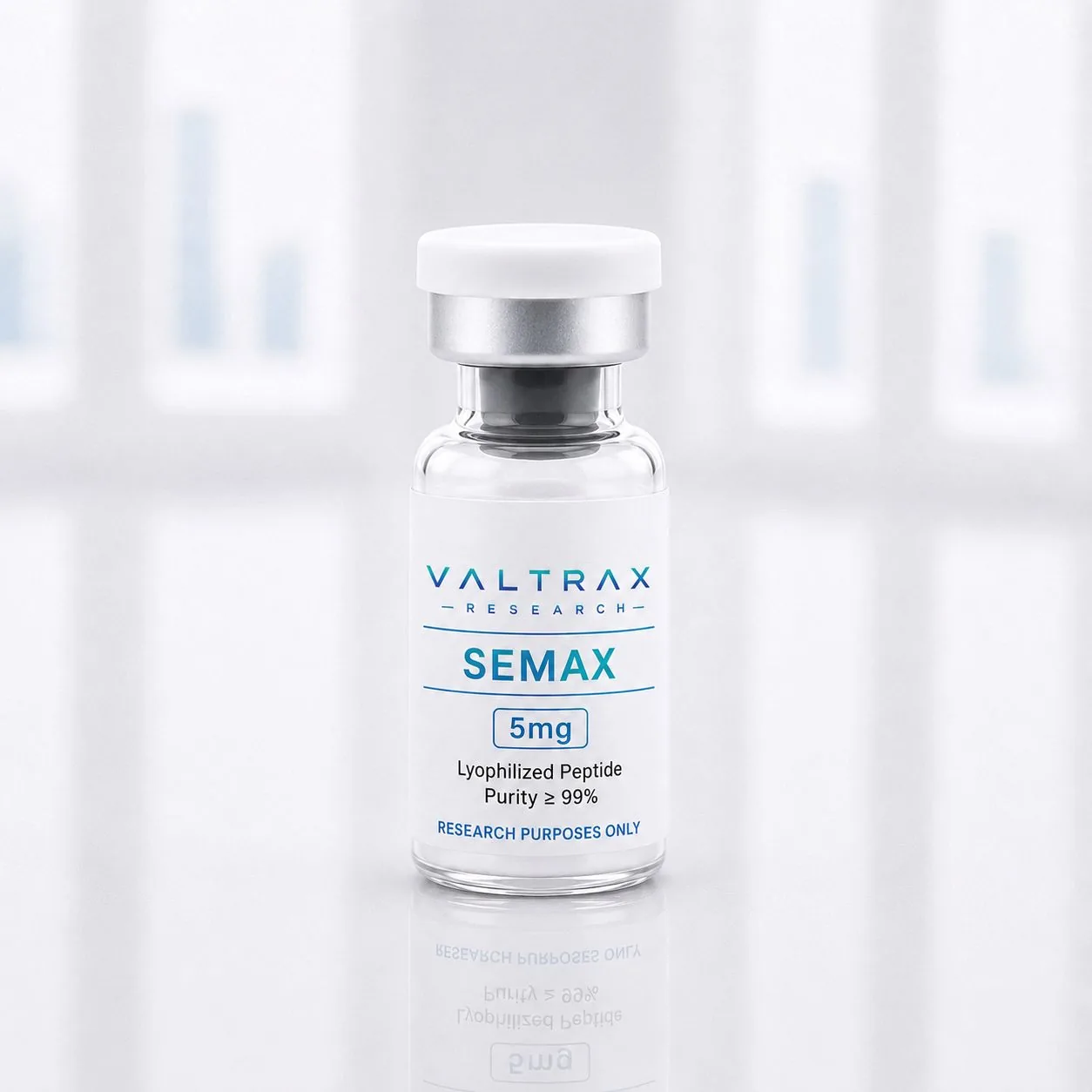
The ACTH(4–7) fragment capped with Pro-Gly-Pro: Met-Glu-His-Phe-Pro-Gly-Pro. Supplied as a lyophilized powder for research purposes only.
Nootropic & Neuromodulatory
$48.00
$60.00
10mg