Cart
Your cart is empty
Find
Semax heptapeptide · ACTH(4–7) + Pro-Gly-Pro
The ACTH(4–7) fragment capped with Pro-Gly-Pro: Met-Glu-His-Phe-Pro-Gly-Pro. Supplied as a lyophilized powder for research purposes only.
Launch Sale · Ends Nov 6
Tested lot by lot at ≥99% purity. The Janoshik certificate for your lot is emailed with the order.
Everything Valtrax Research ships is bench material for in-vitro work. None of it is a drug, a supplement, a cosmetic, or a medical device, and none of it is intended for human or animal use, ingestion, or administration. Placing an order is your confirmation that you are a qualified researcher buying for lawful research, under every Canadian law and regulation that applies to you.
Take the ACTH(4–7) fragment, which on its own has no hormonal pull on cortisol, and cap it with Pro-Gly-Pro. That is Semax: Met-Glu-His-Phe-Pro-Gly-Pro, a seven-residue peptide engineered so the active core survives enzymatic attack long enough to be studied.
The interesting move is the decoupling. By keeping a melanocortin-adjacent fragment but dropping the steroidogenic ACTH signal, the molecule was built to probe the neurotrophic and cognitive side of that peptide family in isolation — which is exactly the lane the lyophilized vial gets used in.
Semax is studied as a neurotrophic agent rather than a single-receptor drug. The consistent findings are raised BDNF and NGF expression in cortical and hippocampal tissue, alongside monoaminergic modulation; behavioral cognition tasks and ischemia/neuroprotection models supply the functional endpoints.
As a dry article, Semax lets a lab set its own solvent and route, then read the same endpoints the molecule is known for: induction of BDNF and NGF in cortical tissue, plus effects on dopaminergic and serotonergic tone. The work treats it as a neurotrophic modulator more than a classical receptor ligand.
Most of the record is Russian in origin, where Semax has been examined across cognition, attention, and ischemic-injury paradigms. The throughline is neuroprotection and neurotrophic support — what a stabilized ACTH fragment does once its hormonal signal has been engineered out.
Semax came out of the Institute of Molecular Genetics in Moscow, where researchers reworked the ACTH(4–10) region to keep a behaviorally relevant core while removing corticotropic activity. Adding the Pro-Gly-Pro tail gave the fragment the stability that earlier ACTH analogues lacked.
The lyophilized form is the original research presentation — dry peptide a lab reconstitutes to its own specification — and it remains the format behind most of the published neurotrophic and cognitive work.
In vitro and animal studies
Semax is a synthetic heptapeptide derived from ACTH(4-10), extended with a Pro-Gly-Pro tail that confers resistance to enzymatic degradation. The design intent was to keep the neurotropic activity of the ACTH fragment while eliminating its corticotropic effect — the peptide does not stimulate cortisol release, which is what separates it from the parent hormone.
The preclinical record, much of it Russian, centres on neurotrophic signalling. Studies report rapid increases in BDNF and NGF expression in the hippocampus, with the BDNF response appearing within hours rather than days — unusually fast, and one of the more distinctive findings. Work also describes modulation of dopaminergic and serotonergic systems.
A substantial body of animal work covers neuroprotection in ischemia models, reporting reduced infarct volume and improved functional recovery after induced cerebral ischemia. Additional studies examine effects on attention and memory in behavioural paradigms, and on the immune and inflammatory response in the injured brain.
The peptide's design illustrates a general principle in this field. ACTH(4-10) is the neurotropic core of a hormone whose corticotropic activity resides in a different region of the molecule, so truncating to that fragment separates two functions the intact hormone performs together. The Pro-Gly-Pro extension then addresses the problem truncation creates: short fragments are cleared almost immediately, and that C-terminal tail confers resistance to aminopeptidase degradation while contributing to transport across the nasal mucosa.
That second property is why the intranasal route dominates the protocols. The olfactory and trigeminal pathways provide access to the central nervous system that bypasses the blood-brain barrier, and for a peptide of this size with negligible oral bioavailability, it is the only practical route. Pharmacokinetic data describing what fraction actually reaches brain tissue in humans has not been published.
Human data, where it exists
Semax occupies an unusual regulatory position. It is registered and used clinically in Russia, where it has been employed for stroke, transient ischemic attack, optic nerve conditions and cognitive indications. That means human clinical use, published Russian clinical literature, and decades of exposure.
It also means an evidence base that has not been validated by the standards applied elsewhere. Most of the clinical work is published in Russian-language journals, much of it predates modern trial reporting conventions, and independent replication by Western groups is essentially absent. Semax holds no approval from Health Canada, the FDA or the EMA, and it has not been through the regulatory review those agencies require.
The honest characterisation is that this is neither an untested compound nor a validated one. There is more human exposure behind Semax than behind most items in this catalogue, and considerably less methodological transparency than behind an approved Western drug.
Common assertions, and what the record supports
The claim that Semax raises BDNF is supported by animal data and is mechanistically coherent. The speed of that response is a genuinely interesting finding.
The claim that it is a proven nootropic overstates what is accessible. The clinical literature exists but is difficult to appraise from outside — trial designs, blinding, endpoint selection and statistical reporting are frequently not described to a standard that permits independent assessment. Citing the existence of Russian clinical use as equivalent to a completed Western trial programme conflates two very different things.
The claim that it is safe because it has been used for decades has some force, and it is the strongest safety argument available for any compound here. It remains an argument from exposure rather than from systematic pharmacovigilance, and it does not identify low-frequency or long-latency effects.
Against the compounds it is most often confused with
Against Selank, its closest counterpart, the two share an origin in the same Russian research tradition and a common intranasal route, but derive from different parent molecules and target different endpoints. Semax comes from ACTH(4-10) and its literature is neurotrophic and neuroprotective, centred on BDNF, NGF and ischemia. Selank comes from tuftsin and its literature is anxiolytic, centred on GABAergic signalling and anxiety-associated gene expression. They are frequently discussed together and are not interchangeable.
Against its own parent, ACTH, the distinction is the point of the molecule: Semax retains neurotropic activity without stimulating cortisol release.
Against the mitochondrial compounds on the longevity shelf, the difference is level of action — Semax modulates neurotrophic and monoamine signalling, while MOTS-c and SS-31 act on cellular energy production.
Adverse findings, toxicology gaps, material hazards
The specific risk profile of Semax is poorly documented by Western standards, and this is the honest headline. Decades of Russian clinical use suggest that severe acute toxicity is unlikely, but systematic adverse event reporting comparable to Western pharmacovigilance does not exist.
Mechanistically, a compound that modulates BDNF, dopaminergic and serotonergic signalling is not pharmacologically trivial. Interactions with psychiatric medication acting on the same systems have not been characterised. Effects on mood and arousal have been reported.
The intranasal route carries its own considerations. Local irritation is reported, and repeated intranasal administration of a preserved solution has consequences for nasal mucosa that are separate from the peptide's own pharmacology.
Long-term effects of sustained neurotrophic factor upregulation have not been studied. BDNF signalling is involved in synaptic plasticity broadly, and chronic pharmacological elevation is not a well-characterised state in humans.
Bench practice for this compound
Semax is a short peptide and comparatively robust. It appears in the literature most often as an intranasal preparation, which is why it is frequently reconstituted at higher concentrations than injectable peptides of similar size.
Reconstitute with bacteriostatic water against the vial wall and swirl gently. Store reconstituted solutions at 2–8 °C protected from light, observing the stated window, and keep unopened lyophilized powder frozen for long-term storage. Avoid repeated freeze-thaw cycling. Because the intranasal protocols in the literature use small volumes at relatively high concentration, prepared solutions are typically made in modest batches and replaced often rather than held for the full nominal window. Verify solvent compatibility against the lot documentation before preparing a stock at any concentration above the usual injectable range.
This summary describes published research. It is not a protocol, not a recommendation, and not a statement that this compound is safe or effective for any use. Not for human or animal use.
Every lot is tested for identity, purity, and net content.
Janoshik Analytical, a laboratory Valtrax does not own, runs the testing — identity by mass spectrometry, purity by RP-HPLC at ≥99%, on the lot you receive.
Same Shelf
Nootropic & Neuromodulatory
$48.00
$60.00
10mg
Nootropic & Neuromodulatory
$48.00
$60.00
10mg
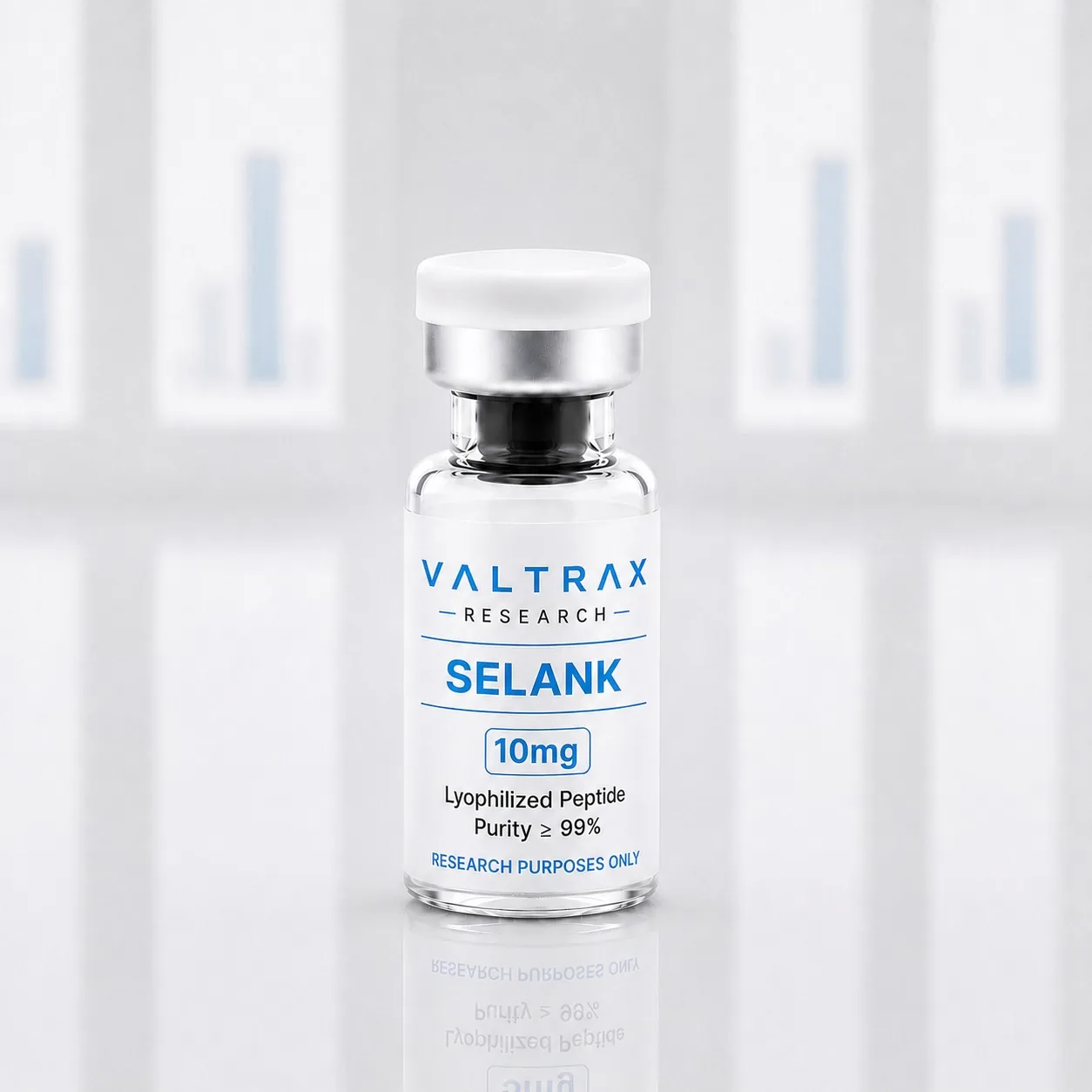
A tuftsin-derived heptapeptide (Thr-Lys-Pro-Arg-Pro-Gly-Pro) stabilized by a Pro-Gly-Pro tail. Supplied as a lyophilized powder for research purposes only.
Nootropic & Neuromodulatory
$48.00
$60.00
10mg