Cart
Your cart is empty
Find
Peptide Bioregulator
Also known as Glu-Asp-Arg (EDR) tripeptide
Launch Sale · Ends Nov 6
Get an email when it restocks
One email the moment it can be ordered — plus sale pricing and new journal entries on Pinealon.
Tested lot by lot at ≥99% purity. The Janoshik certificate for your lot is emailed with the order.
Everything Valtrax Research ships is bench material for in-vitro work. None of it is a drug, a supplement, a cosmetic, or a medical device, and none of it is intended for human or animal use, ingestion, or administration. Placing an order is your confirmation that you are a qualified researcher buying for lawful research, under every Canadian law and regulation that applies to you.
Glu-Asp-Arg — the EDR tripeptide from the Khavinson series, the neural-tissue entry in that catalog. At three residues it is small enough that the standing hypothesis has it crossing the membrane and contacting regulatory DNA without an intermediary.
The claim that keeps surfacing is antihypoxic: neurons coping better when oxygen drops. Pair that with a proposed grip on gene expression and you have the spine of the EDR papers.
Two linked claims drive the work: the EDR tripeptide cushions neurons against oxygen shortfall, and it does so by reaching the gene-regulatory machinery. Endpoints are neuroprotective and antihypoxic. The backing literature is moderate in volume and clustered inside a single research lineage.
The headline endpoint is low-oxygen tolerance — whether the tripeptide keeps neurons operating under hypoxic stress. Behind it sits the looser, harder-to-verify claim that EDR docks at gene-regulatory regions and tilts protein synthesis in the cells it reaches.
The evidence is genuine but slim. Most of it loops back to one bioregulator research lineage rather than to independent replication.
Slotted into the neural branch of the Khavinson bioregulator program — the one where short peptides were assigned by target tissue and run through aging-related models.
That is where the antihypoxic and neuroprotective readouts were worked out. Step outside the lineage and the record gets sparse fast.
A structured evidence summary for this item is still being written. The primary literature listed under Molecule is the starting point in the meantime.
Khavinson, V. et al. (2020). EDR Peptide: Possible Mechanism of Gene Expression and Protein Synthesis Regulation Involved in the Pathogenesis of Alzheimer's Disease
PubMedUmnov, RS. et al. (2013). [Neuroprotective effects of peptides bioregulators in people of various age]
PubMedKozina, LS. (2008). [Investigation of antihypoxic properties of short peptides]
PubMedEvery lot is tested for identity, purity, and net content.
Janoshik Analytical, a laboratory Valtrax does not own, runs the testing — identity by mass spectrometry, purity by RP-HPLC at ≥99%, on the lot you receive.
Same Shelf
Nootropic & Neuromodulatory
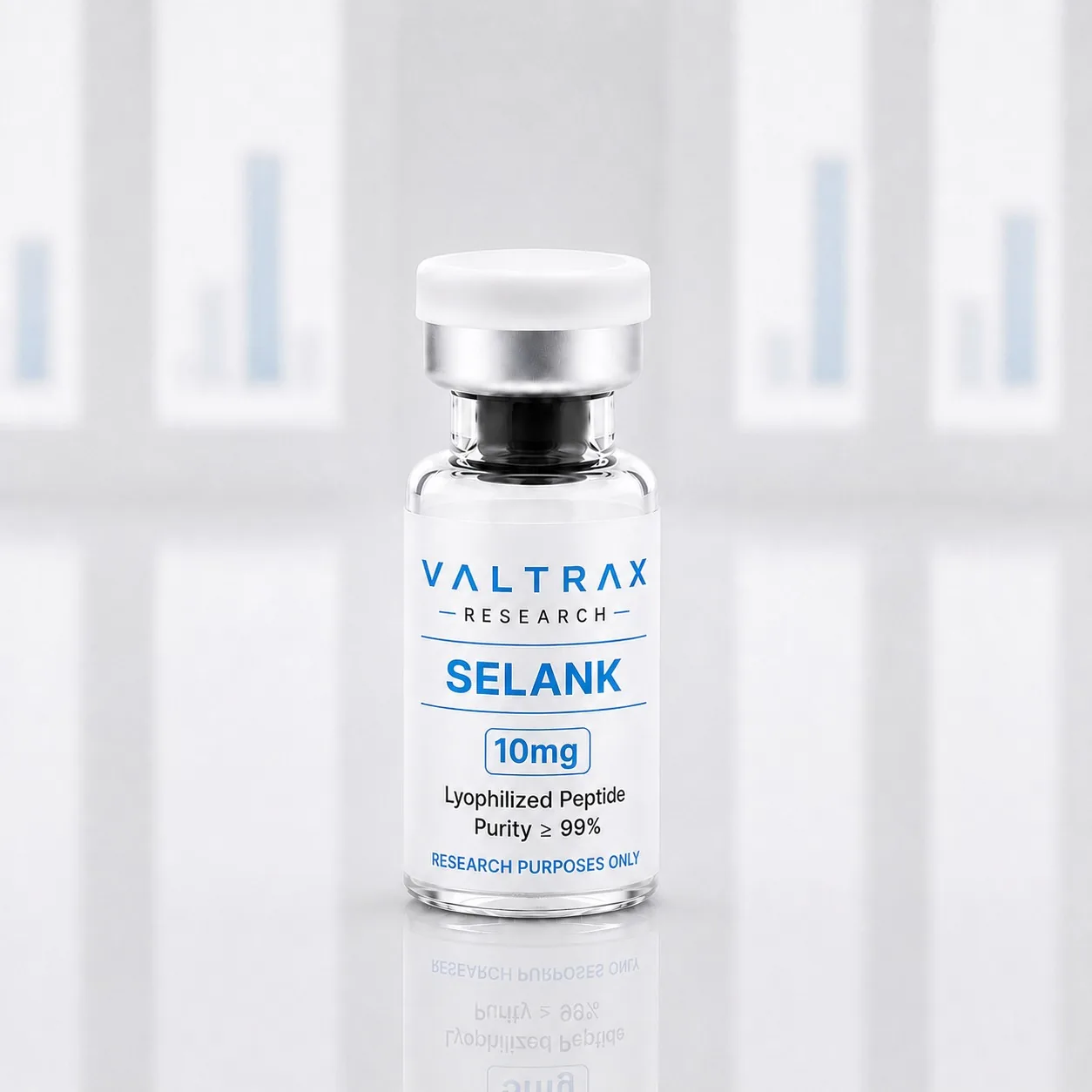
$48.00
$60.00
10mg
A tuftsin-derived heptapeptide (Thr-Lys-Pro-Arg-Pro-Gly-Pro) stabilized by a Pro-Gly-Pro tail. Supplied as a lyophilized powder for research purposes only.