Cart
Your cart is empty
Find
Tuftsin-derived heptapeptide · Thr-Lys-Pro-Arg-Pro-Gly-Pro
A tuftsin-derived heptapeptide (Thr-Lys-Pro-Arg-Pro-Gly-Pro) stabilized by a Pro-Gly-Pro tail. Supplied as a lyophilized powder for research purposes only.
Launch Sale · Ends Nov 6
Tested lot by lot at ≥99% purity. The Janoshik certificate for your lot is emailed with the order.
Everything Valtrax Research ships is bench material for in-vitro work. None of it is a drug, a supplement, a cosmetic, or a medical device, and none of it is intended for human or animal use, ingestion, or administration. Placing an order is your confirmation that you are a qualified researcher buying for lawful research, under every Canadian law and regulation that applies to you.
Selank takes the immune-active tetrapeptide tuftsin (Thr-Lys-Pro-Arg) and welds a Pro-Gly-Pro tail onto it — the same stabilizing trick used on Semax, and for the same reason: a bare four-residue peptide would not last long enough to study. The result is a seven-residue molecule with a half-life worth working with.
The parentage steers the questions. Tuftsin carries immunomodulatory and neuro-regulatory history, and the literature on Selank follows both threads, leaning toward GABA/serotonin-adjacent readouts and the BDNF end of things rather than a single named receptor.
With no assigned receptor, the record is built on consequences rather than binding. Studies measure what Selank does to monoamine and GABAergic signaling, to BDNF in hippocampus and prefrontal cortex, and to cytokine profiles under stress — using behavioral anxiety and withdrawal models as the proving ground.
Selank does not have a tidy single-receptor story, and the research reflects that. Instead of one binding site, the work tracks downstream signatures — shifts in monoamine balance, modulation of GABAergic tone, and changes in BDNF and cytokine expression — treating those as the fingerprint of its activity.
The Russian-origin literature is where most of it sits. Kolik’s BDNF work in hippocampus and prefrontal cortex, Yasenyavskaya’s cytokine readouts under social stress, and Konstantinopolsky’s withdrawal models together sketch a peptide studied through its effects on neurochemistry rather than a named target.
Selank was designed at the Institute of Molecular Genetics in Moscow as a stabilized analogue of tuftsin — the goal being to keep tuftsin’s regulatory activity while extending a half-life too short to be useful on its own. The Pro-Gly-Pro extension solved the durability problem.
From there the research program broadened from the immune-peptide roots of tuftsin into anxiety, stress, and cognition models, the areas where the bulk of the published Selank work now lives.
In vitro and animal studies
Selank is a synthetic heptapeptide built from tuftsin, an immunomodulatory tetrapeptide fragment of the immunoglobulin G heavy chain, extended with a Pro-Gly-Pro sequence that resists enzymatic degradation. That dual heritage — immune peptide plus stabilising tail — is why its literature runs in two directions at once.
The anxiolytic strand is the larger one. Animal work reports reduced anxiety-related behaviour in standard paradigms, with published mechanisms including modulation of GABAergic signalling and changes in the expression of genes associated with anxiety. Studies also describe effects on serotonin metabolism and on the balance of monoamine turnover in brain regions involved in emotional regulation.
What distinguishes it from benzodiazepine comparators in the preclinical literature is the reported absence of sedation, motor impairment, tolerance and withdrawal in the animal models — a claim that recurs consistently across the Russian work.
The immunomodulatory strand, inherited from tuftsin, covers effects on interleukin expression and immune cell activity, and connects to a smaller literature on antiviral activity.
Human data, where it exists
Selank has been used clinically in Russia, where it is registered for anxiety disorders, and there is published Russian clinical literature reporting anxiolytic effects in generalised anxiety and related conditions, sometimes in comparison with benzodiazepines.
As with Semax, the difficulty is appraisal rather than existence. The clinical work is largely Russian-language, frequently predates modern trial reporting standards, and has not been independently replicated by groups outside that tradition. Trial designs, blinding procedures and statistical handling are often not described in enough detail to assess.
Selank holds no approval from Health Canada, the FDA or the EMA, and has not been through their review processes. Human pharmacokinetic characterisation to Western regulatory standard has not been published.
So there is real human exposure and real clinical claims behind this compound, and an evidence base that cannot be independently verified from outside.
Common assertions, and what the record supports
The claim that Selank is anxiolytic without sedation or dependence is the central claim, and it is consistently reported across the animal literature. It is mechanistically plausible, since the compound does not act as a direct GABA-A positive allosteric modulator in the way benzodiazepines do.
What cannot be verified from outside is the clinical part of that claim. Reports of comparable efficacy to benzodiazepines with a better tolerability profile would be significant if independently confirmed, and they have not been.
The claim that a peptide derived from an endogenous immune fragment is inherently safe does not follow. Tuftsin is a natural fragment; Selank is a modified analogue with a stabilising extension designed specifically to persist longer than the natural molecule would.
Claims of nootropic or cognitive enhancement are weaker than the anxiolytic claims. The literature that exists is mostly about anxiety, and reduced anxiety can improve cognitive performance without any direct nootropic action.
Against the compounds it is most often confused with
Against Semax, the pairing is natural and the distinction matters. Both are Russian-developed, both are short stabilised peptides, both are used intranasally. Semax derives from ACTH(4-10) and its literature centres on BDNF, NGF and neuroprotection. Selank derives from tuftsin and its literature centres on anxiety, GABAergic signalling and immune modulation. They address different endpoints and are not substitutes.
Against benzodiazepines, which the Russian literature uses as the standard comparator, the reported difference is efficacy without sedation, tolerance or withdrawal — the claim that gives the compound its interest, and the one least verifiable from outside.
Against KPV, both trace back to immune-active peptide fragments, but KPV comes from alpha-MSH and acts peripherally on inflammatory signalling, while Selank's principal reported activity is central.
Adverse findings, toxicology gaps, material hazards
As with Semax, the honest position is that the risk profile is poorly documented by Western standards. Russian clinical use suggests severe acute toxicity is unlikely; systematic pharmacovigilance data comparable to Western reporting does not exist.
A compound that modulates GABAergic and serotonergic signalling has real potential for interaction with psychiatric medication acting on the same systems, and those interactions have not been characterised. This is the most practically important gap.
The immunomodulatory activity inherited from tuftsin is not a side note. Altering interleukin expression and immune cell activity has consequences that have not been mapped in humans over extended exposure, particularly in anyone with autoimmune or immune-mediated conditions.
Intranasal administration carries local considerations independent of the peptide — mucosal irritation with repeated use, and the effects of preservative-containing solutions on nasal tissue.
Long-term consequences of sustained anxiolytic peptide exposure have not been studied.
Bench practice for this compound
Selank is a short, comparatively stable peptide and dissolves readily. Because the published protocols are predominantly intranasal, it is often reconstituted at higher concentrations than injectable peptides of similar size.
Introduce bacteriostatic water against the vial wall and swirl gently rather than shaking. Store reconstituted solutions at 2–8 °C protected from light and observe the working window given on this page. Keep unopened lyophilized powder frozen for long-term storage and avoid freeze-thaw cycling.
This summary describes published research. It is not a protocol, not a recommendation, and not a statement that this compound is safe or effective for any use. Not for human or animal use.
Konstantinopolsky, M.A. et al. (2022). Selank, a Peptide Analog of Tuftsin, Attenuates Aversive Signs of Morphine Withdrawal in Rats.
PubMedYasenyavskaya, A.L. et al. (2021). The Influence of Selank on the Level of Cytokines Under the Conditions of "Social" Stress. Curr Rev Clin Exp Pharmacol 16(2):169–173.
PubMedKolik, L.G. et al. (2019). Selank, Peptide Analogue of Tuftsin, Protects Against Ethanol-Induced Memory Impairment by Regulating BDNF Content in the Hippocampus and Prefrontal Cortex in Rats.
PubMedVanhee, C. et al. (2020). The occurrence of putative cognitive enhancing research peptides in seized pharmaceutical preparations: An incentive for controlling agencies to prepare for future encounters of the third kind. Drug Test Anal 12(1):63–73.
PubMedThe certificate for your lot reports measured identity, purity, and net content, and is sent by email.
Janoshik Analytical, a laboratory Valtrax does not own, runs the testing — identity by mass spectrometry, purity by RP-HPLC at ≥99%, on the lot you receive.
Same Shelf
Nootropic & Neuromodulatory
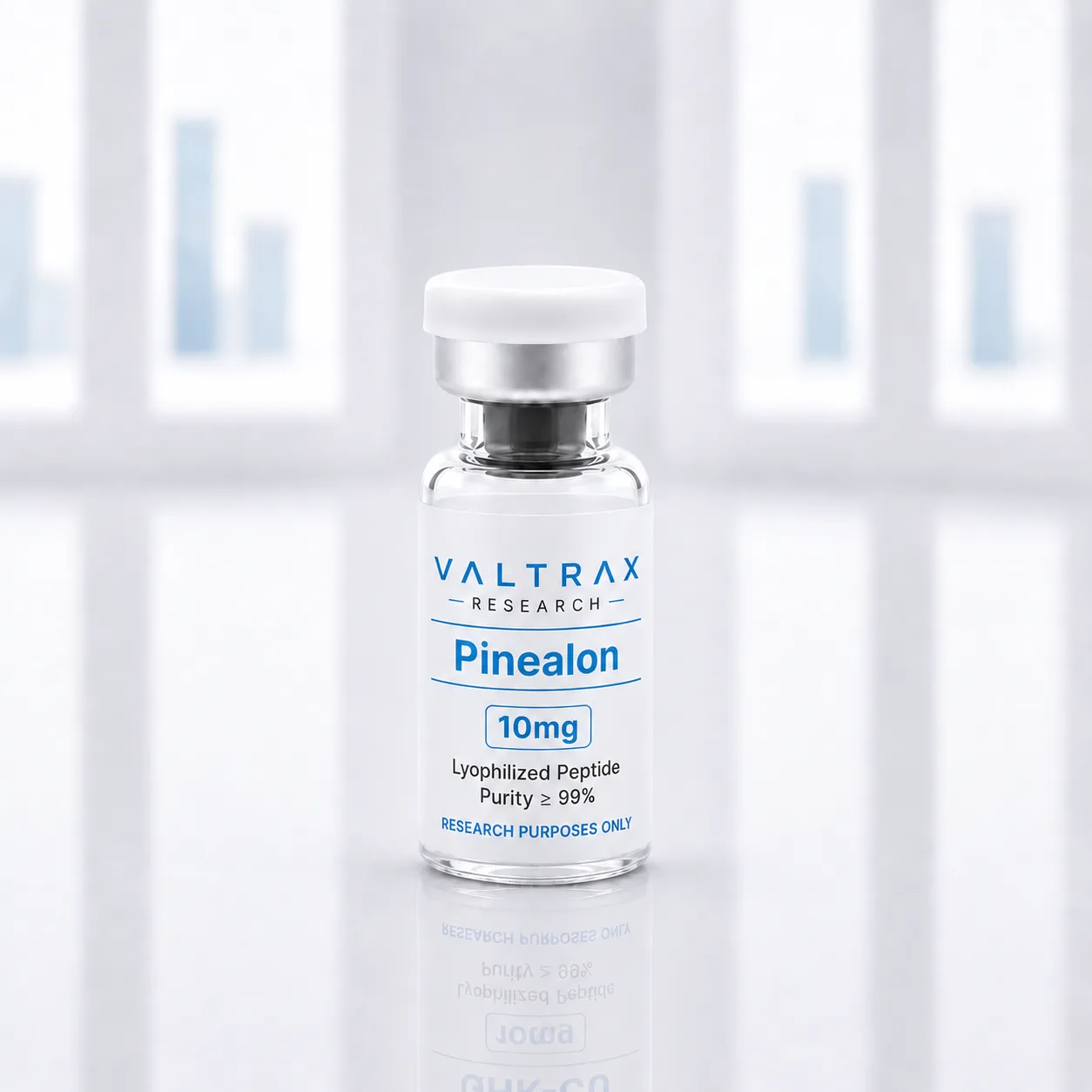
$48.00
$60.00
10mg
Nootropic & Neuromodulatory
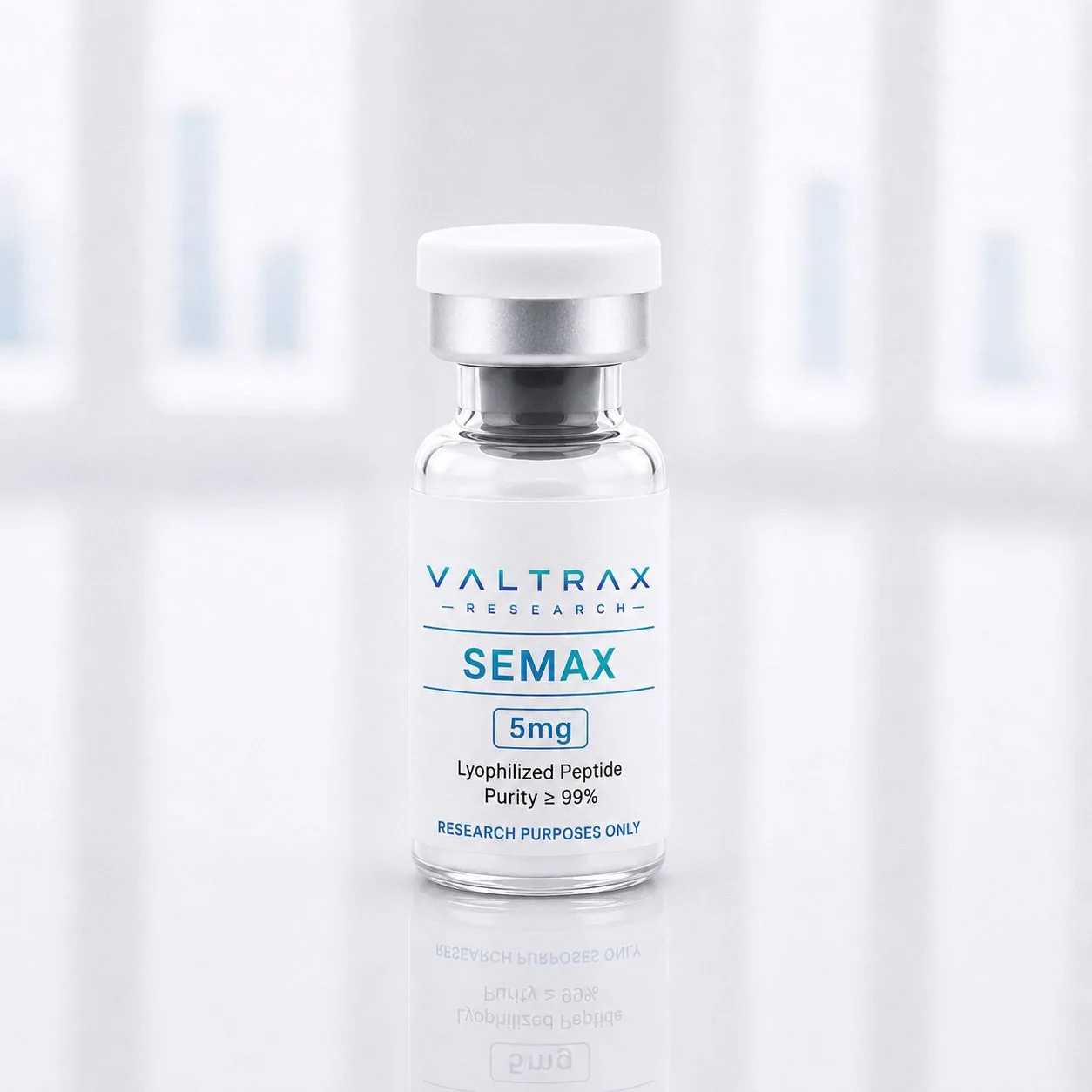
$48.00
$60.00
5mg
The ACTH(4–7) fragment capped with Pro-Gly-Pro: Met-Glu-His-Phe-Pro-Gly-Pro. Supplied as a lyophilized powder for research purposes only.
Nootropic & Neuromodulatory
$48.00
$60.00
10mg