Valtrax Research is opening — leave your email and we'll ping you the moment the first compounds are listed.
Every lot tested by Janoshik Analytical


Cart
Your cart is empty
Find
Valtrax Research is opening — leave your email and we'll ping you the moment the first compounds are listed.
Your cart is empty
NAD+ redox coenzyme · 1000 mg
Nicotinamide adenine dinucleotide, the redox coenzyme that shuttles electrons through nearly every cellular redox step. Supplied as a lyophilized powder for research purposes only.
Catalog opens shortly. Leave your address and we will ping you the moment this compound is orderable.
Tested lot by lot at ≥99% purity. The Janoshik certificate for your lot is emailed with the order.
Everything Valtrax Research ships is bench material for in-vitro work. None of it is a drug, a supplement, a cosmetic, or a medical device, and none of it is intended for human or animal use, ingestion, or administration. Placing an order is your confirmation that you are a qualified researcher buying for lawful research, under every Canadian law and regulation that applies to you.
NAD+ is not a drug candidate — it is one of the oldest pieces of cellular machinery, the dinucleotide that shuttles electrons between nicotinamide and adenine in nearly every redox step a cell runs. As a bench reagent it underwrites enzyme studies, mitochondrial respirometry, and any experiment where the question is energy currency rather than a target.
What keeps it current is consumption. Sirtuins, PARPs, and CD38 all spend NAD+ as a substrate, so its pool size has become a readout in its own right — which is why aging and metabolic-stress models keep coming back to how the molecule is made, used up, and salvaged.
The pool is the throughline. Studies treat NAD+ level and turnover as the dependent variable — measuring how precursor supply, sirtuin/PARP/CD38 consumption, and mitochondrial demand push it up or down, and what those swings do to respiration, oxidative-stress handling, and cell survival.
On the bench NAD+ functions as both reagent and readout. As a cofactor it feeds dehydrogenase studies and respirometry; as a substrate it is steadily drained by sirtuins, PARPs, and CD38, so the size and turnover of the pool become measurable proxies for metabolic state.
The modern literature is built on that drain. Cantò and Trammell trace how precursors feed the salvage route, while Ying’s work maps NAD+ and NADH onto cell-death and oxidative-stress endpoints — together framing the molecule less as a static cofactor than as a balance sheet the cell keeps rewriting.
NAD+ entered biochemistry through fermentation: Harden and Young flagged a heat-stable “coferment” in yeast extract at the turn of the last century, and the structure was pinned down over the decades that followed as the role of the nicotinamide–adenine dinucleotide in respiration came clear.
The contemporary chapter is about the salvage pathway. Once NAD+ was shown to be consumed rather than merely recycled, attention moved to its precursors and to the enzymes that spend it, which is where most current bench work now sits.
In vitro and animal studies
NAD+ is not a peptide. It is nicotinamide adenine dinucleotide, the central redox cofactor of metabolism, and its biochemistry is settled science rather than an open research question. It carries electrons in glycolysis, the citric acid cycle and oxidative phosphorylation, and it is the obligatory cosubstrate for the sirtuin deacetylases and the PARP enzymes involved in DNA repair.
What is genuinely under research is the consequence of its decline. Tissue NAD+ falls with age across every species examined, and the mechanisms proposed include increased consumption by PARPs responding to accumulated DNA damage, increased activity of the NADase CD38, and reduced salvage synthesis. Because sirtuins require NAD+, falling levels reduce sirtuin activity, which connects the cofactor to a large literature on metabolic regulation and cellular ageing.
Rodent work on precursor supplementation — nicotinamide mononucleotide and nicotinamide riboside — reports raised tissue NAD+ and improvements across metabolic, vascular, muscular and cognitive endpoints in aged animals.
Human data, where it exists
The human evidence concerns precursors far more than NAD+ itself, and this distinction is the crux of the entire field.
Controlled human trials of nicotinamide riboside and nicotinamide mononucleotide have consistently shown that oral precursor supplementation raises blood NAD+ measurably and is well tolerated at studied doses. That much is established. What those trials have not consistently shown is a corresponding functional benefit — results for insulin sensitivity, muscle function, cardiovascular measures and cognition have been mixed and generally modest, with several well-conducted trials reporting no significant effect on the primary endpoint.
Direct NAD+ administration, including by intravenous infusion, is widely offered commercially and has a much thinner evidence base. NAD+ is a large charged molecule with poor cell membrane permeability, and there is genuine scientific debate about whether administered NAD+ enters cells intact or is degraded extracellularly to precursors that are then taken up — which would make it an expensive route to the same place.
Common assertions, and what the record supports
The claim that NAD+ declines with age is true and well documented. The claim that restoring it reverses ageing is not supported by human data, and the gap between those two statements is where most marketing operates.
The most specific unsupported claim concerns direct administration. Raising blood NAD+ is not the same as raising intracellular NAD+ in the tissues that matter, and the membrane permeability problem is a real biochemical obstacle rather than a quibble. The precursor route exists precisely because cells take up precursors more readily than the intact cofactor.
A second claim treats the strong rodent results as predictive. Mouse lifespan and healthspan studies have repeatedly failed to translate, and NAD+ biology involves species differences in salvage pathway enzymes that make extrapolation particularly unreliable.
The fair summary is that NAD+ biology is real and important, and that the intervention question in humans remains substantially unresolved after a decade of well-funded study.
Against the compounds it is most often confused with
Against 5-Amino-1MQ on the metabolic shelf, the relationship is elegantly opposite. NAD+ approaches add substrate to the pool; NNMT inhibition reduces the drain on it by preventing methylation of nicotinamide. Two routes to the same endpoint, neither demonstrated in humans to produce a functional outcome.
Against the precursors NMN and NR, the difference is the membrane permeability question — precursors are taken up readily, the intact cofactor much less so, and essentially all of the good human trial data belongs to the precursors rather than to NAD+ itself.
Against MOTS-c and SS-31 on the same shelf, NAD+ is substrate while those are signalling and structure respectively. SS-31 stabilises the membrane platform on which oxidative metabolism runs; MOTS-c modulates the signalling governing it; NAD+ is the cofactor the process consumes. Conceptually complementary, and none established in healthy human ageing.
Adverse findings, toxicology gaps, material hazards
NAD+ and its precursors are generally well tolerated in the doses used in published trials, and this is a genuine finding from real controlled studies rather than an absence of data.
The substantive concern is theoretical but not frivolous. NAD+ is required by PARP enzymes for DNA repair and by sirtuins for regulating cell survival pathways, and these processes matter to cancer biology in both directions. Some published work has raised the possibility that raising NAD+ availability could support the metabolic demands of existing malignant cells. No human study has demonstrated harm; equally, no study has adequately addressed the question, and it is raised in the scientific literature rather than only by critics.
High-dose nicotinamide can cause flushing and, at sustained high intake, hepatotoxicity has been reported. Methyl group depletion has been proposed as a consequence of high nicotinamide loads, since clearance proceeds by methylation — the same pathway NNMT inhibitors target from the other side.
Intravenous administration carries risks independent of the molecule, including infusion reactions and infection from non-sterile preparation.
Bench practice for this compound
NAD+ is a nucleotide cofactor rather than a peptide, and it is notably less stable in solution than the lyophilized peptides in this catalogue. It is sensitive to heat, to pH extremes, and hydrolyses over time in aqueous conditions.
Reconstitute only when needed and use promptly. Store reconstituted material at 2–8 °C protected from light, and treat the working window as shorter than for a typical peptide. Keep unopened lyophilized material frozen. Solutions should not be heated, and repeated freeze-thaw cycling should be avoided.
This summary describes published research. It is not a protocol, not a recommendation, and not a statement that this compound is safe or effective for any use. Not for human or animal use.
Ying, W. (2006). NAD+ and NADH in cellular functions and cell death.
PubMedCantó, C. et al. (2012). The NAD(+) precursor nicotinamide riboside enhances oxidative metabolism and protects against high-fat diet-induced obesity.
PubMedTrammell, S.A.J. et al. (2016). Nicotinamide riboside is uniquely and orally bioavailable in mice and humans.
PubMedJanoshik Analytical measures identity, purity, and net content, lot by lot.
Janoshik Analytical, a laboratory Valtrax does not own, runs the testing — identity by mass spectrometry, purity by RP-HPLC at ≥99%, on the lot you receive.
Same Shelf
Longevity & Mitochondrial
$60.00
10mg
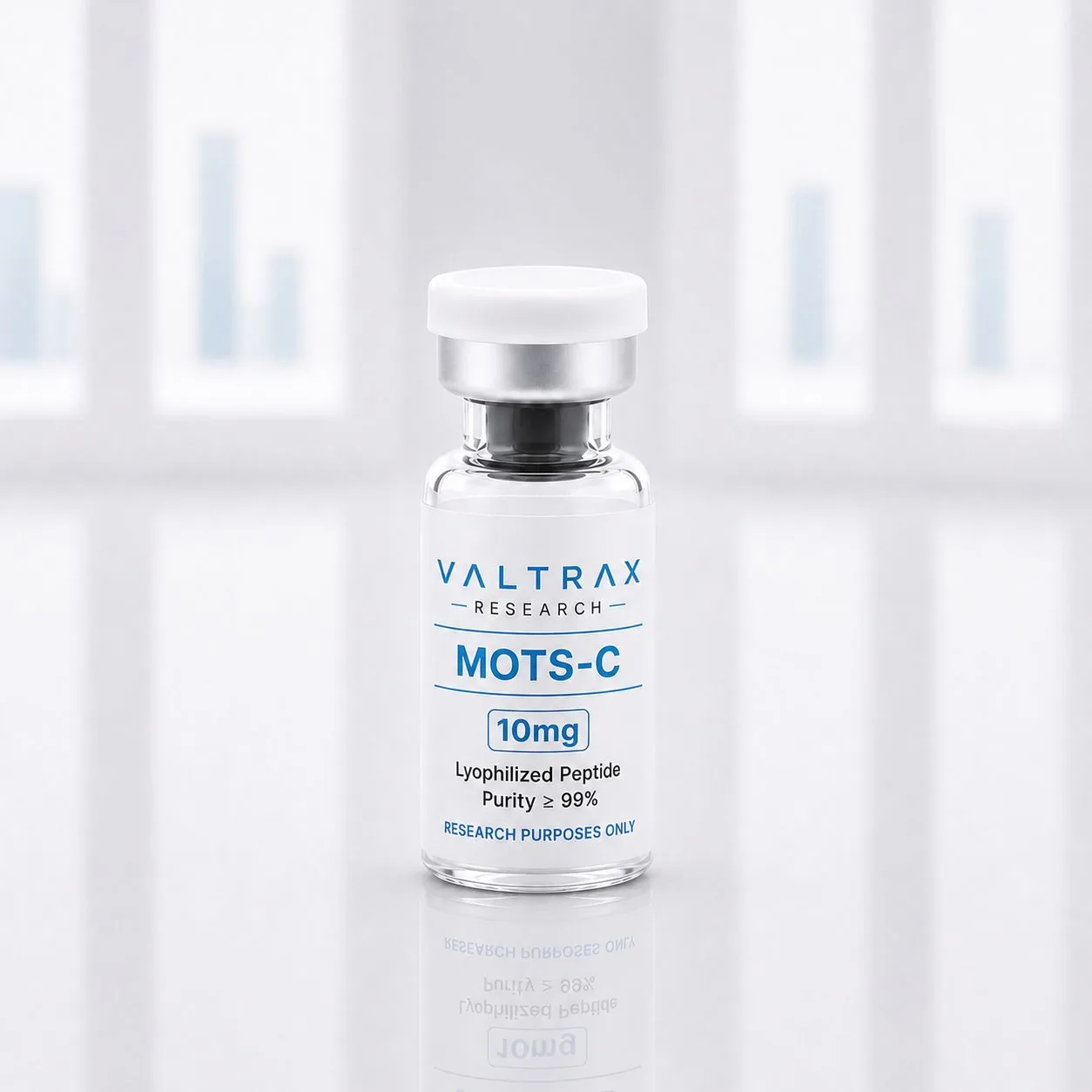
A 16-residue peptide encoded inside the mitochondrial 12S rRNA gene rather than the nuclear genome. Supplied as a lyophilized powder for research purposes only.
Longevity & Mitochondrial
$70.00
10mg
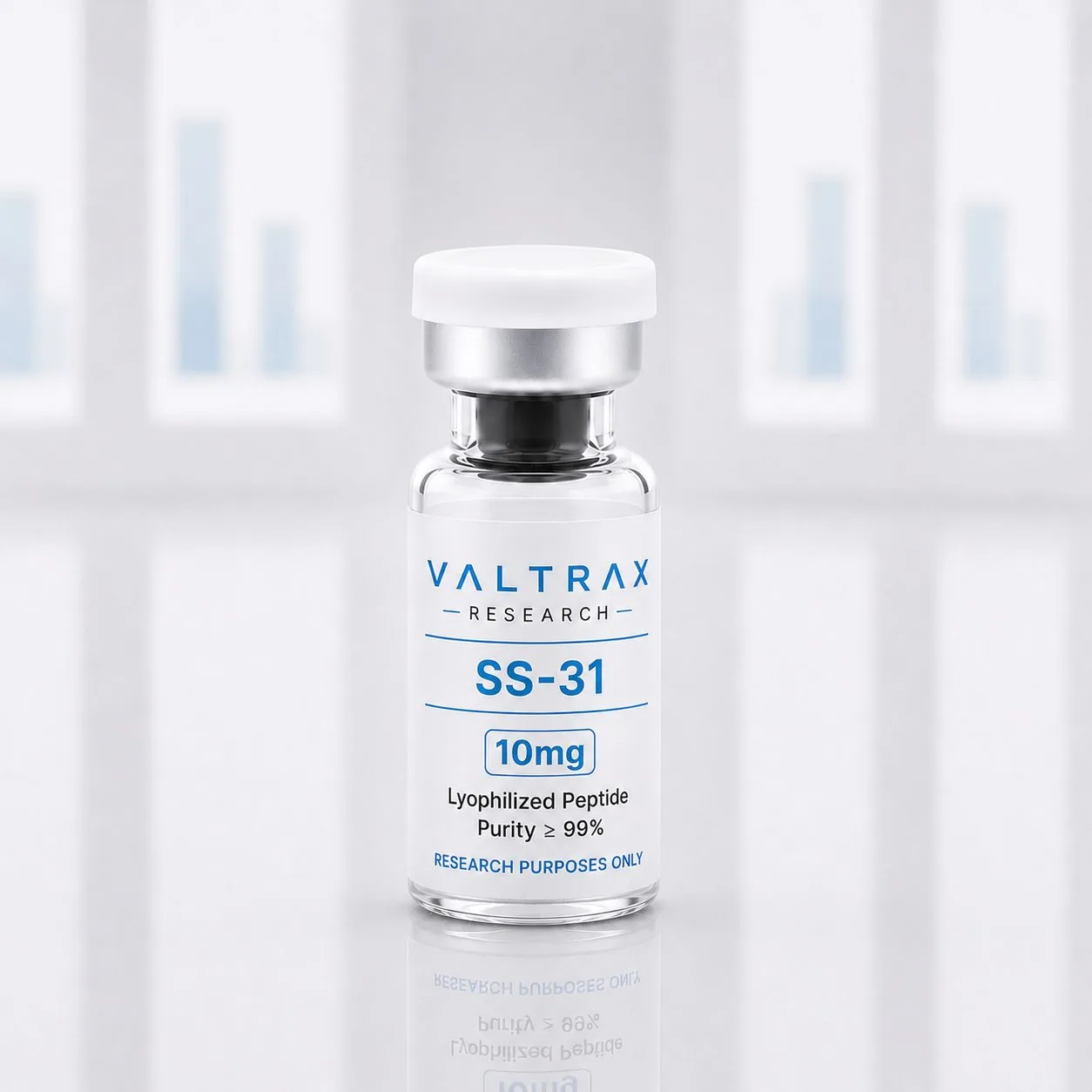
A cardiolipin-binding tetrapeptide (D-Arg-Dmt-Lys-Phe), also filed as elamipretide. Supplied as a lyophilized powder for research purposes only.